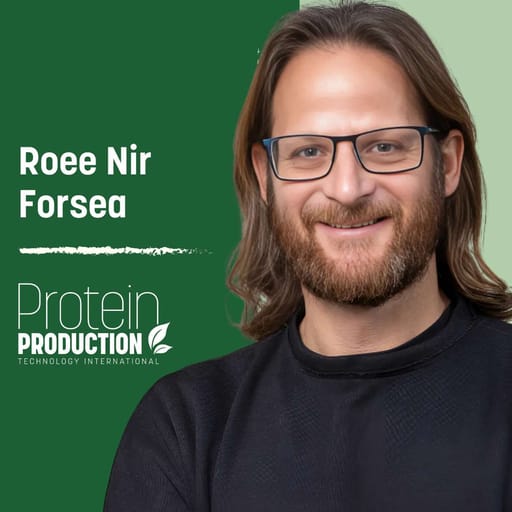
Transcript 0:00 [upbeat music] Welcome to the Protein Production Technology International Podcast. We explore the latest advancements in alternative proteins, from cultured meats to plant-based proteins. 0:11 We talk to experts and innovators who are working towards a more sustainable, efficient, and kind protein system. Join us as we dive into the exciting possibilities of the alternative protein industry. Okay. 0:25 I'm joined now by Rui Nir. He's the co-founder and CEO of Forsea, um, that's a company pioneering cultivated seafood with a particular focus on freshwater eel. 0:34 Uh, it's an exciting space with big implications for the future of protein, and I'm looking forward to exploring the company's mission, uh, technology, and strategy with Rui today. It's not the first time. Welcome, Rui. 0:46 Hi, Nick. Thanks, thanks for having me here today. It's an absolute pleasure. To speak with you. Yeah. Um, to start us off, Rui, um, could you just introduce Forsea for readers who may not be aware of the company? 0:57 What, what's your mission, and how do you see your role within the cultivated seafood space? Yeah. Of course. So Forsea is a cultivated fish and seafood company with a very unique technology, um, to produce 1:12 various, uh, uh, now-- various cultivated fish and seafood products. Um, we have a very unique technology, uh, that is based on organoids, mini tissues that continuously differentiate to the edible cells a-altogether. 1:27 We have unique cell lines. Uh, we start from embryonic stem cells, 1:32 um, and that really allowed us to design and implement a very unique process that is very much cost-effective and could bring, um, um, to the consumers vast amounts of fish and, uh, sea-seafood products at low prices. 1:51 Mm-hmm. I'm also interested in your own personal story. So what motivated you to, to enter this space in the first place, and, and why did you decide to build Forsea around that vision? So, um, 2:04 spent the earlier, uh, years of my career in the biotech, health tech, and food tech, uh, industries. I'm a biotech engineer, but most of my career I've been in the business side of the companies that I work for. 2:19 And I'm a big, uh, ocean lover. Uh, I surf. I surf with, uh, my kids, um, and the ocean really li- [audio glitch] my, uh, my li- [audio glitch] 2:31 And, um, after several years in the food tech and then in the health tech, I decided that I would like to pursue, um, new, uh, venture that will combine it all. 2:45 And, uh, then, you know, we're talking about two thousand and, uh, twenty-one, uh, the hype, uh, twenty... Yeah, twenty one, the hype around cultivated meat was a-at its highest. 2:58 So, uh, um, I was seeking to establish a company in the space that will combine my passions. And, uh, then, uh, [audio glitch] 3:09 partners, uh, professors from, uh, Tel Aviv University and the Hebrew University of Jerusalem, and we co-founding Forsea. And Moriya, uh, my co-founder, the CTO, joined immediately after. 3:23 A-and when you look at the, the broader alternative protein landscape, cultivated seafood, it's often, uh, overshadowed, shall we say, by beef or chicken. Where do you see it fitting in over the next decade or so? 3:36 That we really felt back in the day that, uh, it's quite a wild, uh, space. You know, the, the, uh, other co-founders were pushing to, uh, uh, beef, uh, uh, or chicken. 3:51 And, you know, with my-- I, I wanted, of course, to, to focus on, on the fish and seafood. Um, but from-- also from, you know, business per-perspective, I felt that the opportunity is the highest in this space. 4:05 Also, if you think about it, you know, fish and seafood has a lot of niche, uh, markets, uh, with high value. 4:12 So, you know, you have only beef and only chicken, but in the fish and seafood you have the shrimp and lobster and eel and, um, uh, sea bream. You know, you can play with different types of, uh, of animals. 4:29 And, um, and, uh, I think that with the cl- significant climate cha-change that we've seen in the recent years, the cultivated fish and seafood, uh, uh, domain will take a very, uh, central role in the consumption of alternative, uh, proteins a-across the globe. 4:52 Mm-hmm. I'm gonna talk about the technology now. One of the long-running challenges in, in cultivated seafood is cost, um, as it is in cultivated meat as well. 5:00 In your view, what specific technological breakthroughs, whether that's cell lines or media or bioprocessing, what, um, breakthroughs are going to be decisive in pushing cultivated fish towards price parity? 5:13 So there have been a lot of innovation in recent years. You, you, you may recall that, uh, the... 5:18 I would say the first generation companies used to consume very large amounts of very expensive ingredients in order to develop their, uh, products. You know, these ingredients were taken from pharma. 5:33 Also, the technology, uh, was taken from, uh, biotech, uh, uh, concepts. Um, but in recent years, first of all, the media, uh, costs went down significantly, but also companies, 5:51 uh, optimized their processes to consume and their cell lines to consume far less, uh, media ingredients. Mm-hmm. And also processes becameFar more efficient. And, uh, you know, the... 6:05 I would say the second generation companies such as 4C were established in order to conceptually at least solve part, uh, of these, uh, problems. 6:16 If you look at 4C, you know, we started with the o- the organoid technology, uh, in order to save media costs and, you know, growth factors and, and, uh, waive the scaffolding stage. 6:28 But what we found out is also that the fact that we are the only ones in the world that are using embryonic stem cells, pluripotent stem cells, uh, to, to, uh, cultivate meat, or in our case, cultivate fish and seafood. 6:44 Uh, this allowed us to also develop a very unique and efficient continuous harvesting process. And that's also reduced the, um, the cost of, uh, the production of cultivated, uh, uh, fish for us significantly. 7:02 Um, probably we are the only one company in the world-- the only company in the world that is, you know, because of our very unique process, we can produce, uh, externally at CMOs, um, and still reach, uh, far below price parity prices, make profit of it. 7:22 Yeah. And that, you know, as I said, because of the organoid technology, because of the unique ce- cell line, and also because of the process that we were able to, uh, assemble to support it. Mm-hmm. 7:35 Beyond, um, things like media costs and, and cell lines, wh-where else do you see opportunities for, uh, efficiency gains that could help cultivate seafood compete with, um, aquaculture and wild catch? 7:47 I think that from now on, it's process, process, process. Mm-hmm. So, you know, we, we have to... Because the technology already is out there to, uh, use far less amounts of media. 8:01 Uh, the media costs, uh, by the suppliers or using, you know, internal technologies, uh, decreased significantly to very low, uh, numbers for certain, uh, types of cell lines. 8:13 And now, uh, the saving, the, the saving would have to come from the engineering part of the business. Now, you look at the company such as Four C that was built to produce, you know, up to the finished product. 8:25 So we have the, uh, cell line, uh, division, we have the media division, we have the engineering, and we have the food division. And now what w- what we expect to bring the cost saving is the engineering. 8:39 You know, designing a, a, a continuous processes, reaching high cell densities in the bioreactors. Harvesting, uh, uh, in the right, uh, time points, uh, in the right quantities. 8:56 And so to, to that, you have to design a very, uh, uh, efficient process, and that will drop the prices to below, uh, the conventional alternatives. Yeah. It's funny you should say that actually. 9:11 There are quite a few people arguing that, um, cultivated fish might one day fall below, um, parity with conventional seafood. Um, do you think that's realistic? 9:20 And, and if so, um, what innovations might have to happen to make that im- that possible? Actually, we see... we already see the roadmap to that. 9:29 You know, the, the fact that we are able to use fairly small bioreactors and still be below, uh, 9:38 uh, you know, to, to reach profitability, uh, for premium products, really allows us to plan how when we, uh, uh, scale up to larger bioreactors, we reach to very low single digit, uh, uh, cost of, you know, um, uh, products. 9:58 And that will allow us to target not only the premium fish such as the eel, but also, uh, far cheaper whitefish types. Mm-hmm. 10:10 Um, you've spoken about, um, leveraging CMOs instead of building, um, production facilities in-house. That's a, a strategic choice that not everyone makes. 10:19 What are the, the technical and business considerations behind that, and how do you think it affects scalability? So we learned during our funding processes that investors do not like to pay for CapEx. Mm-hmm. 10:36 Um, many companies, at least the earlier, uh, the, the, the, the companies that were the first in the market, had to design our own processes, and that required a lot of CapEx. 10:49 And, you know, once such fundings was, was available, but I'm not sure that, uh, it's, it's available, at least from the VC perspective, that it's available anymore. Mm-hmm. And, um, 11:06 and you know, when we looked at the figures that we can reach with our processes, we came to the conclusion that with our-- with the process that we develop, we, we do not really need to ask investors to fund, uh, CapEx. 11:24 Um, and we will, uh, uh, start... We started, uh, looking for the right, uh, CMO to, um, to-- where we can produce. We identified several candidates, and, uh, now we're planning to do so. Mm-hmm. 11:39 And CMOs, they usually have deeper expertise in bioprocessing, but food is a very different beast. 11:45 So how do you ensure that your, um, cultivated seafood still delivers sensory quality and the consistency that consumers expect when you're outsourcing production? 11:56 Now, how do you, how do you ensure that they look after your babies, is what I'm saying [chuckles]? So first of all, you know, uh, I guess again, this, this industry is evolving. 12:05 In the-- At the beginning, there were no-Uh, cultivated meat CMOs the earlier years, but in recent years, there have been several companies that were established in order to serve the cultivated, uh, meat space. 12:19 So they are... Globally, there are s-several CMOs that are good, uh, they have good, uh, flow equipment and quality standards, and, and also part of them are 12:33 produced in, in, in companies launched products and cost regulatory approvals with, with products that, uh, that were produced in their locations. Mm-hmm. 12:43 Um, you know, at the end of the day, we-- our, our process is very well protected along the, uh, value chain. Mm-hmm. Um, we have, uh, unique isolation methods, we have unique media, 12:59 uh, and, and we have a unique process. So the process is something that we will have, we will have to, uh, of course, uh, convey to the, um, to the, uh, um, CMOs that we will be working with. 13:14 But the other, uh, two elements are something that we can keep in our, uh, proprietary. You know, how we isolate the cells and how we establish the cell lines, as well as we are using. 13:31 Um, so on one end, uh, we make sure that we keep, you know, protecting our IP from, you know, uh, from, you know, submitting patents and so on. 13:42 But on the other end, we do not have to disclose everything to the CMO where we will be working. Mm-hmm. 13:50 Um, if we zoom out to the systems level, um, Rui, how does cultivated fish integrate into a global protein supply chain, especially alongside, you know, the traditional forms such as aquaculture or even plant-based seafood alternatives? 14:06 I always see it as a, you know, a new segment. And, um, [sighs] at the end of the day, cultivated meat... 14:18 Also the regulatory, uh, bodies will not label it as, as, as the, you know, as the or- as this... Cultivated fish will not be labeled as the same as, you know, fished, uh, fish. Mm-hmm. 14:31 So there is a distinction that is really embedded within this product, and this is a new segment, uh, that will be consumed by, uh, the consumers, um, uh, around, around the globe. We have very delicious product. 14:45 So at least from taste, uh, point of view, and also pri-price point of view, we deliver very attractive product, which is compli- which are complementary to the other products that are available in the market. Mm-hmm. 14:59 Um, you know, each one of these product that you mentioned, either the, um, fished fish or, you know, the aquaculture one, or the plant-based, have their own space, and we will create with our, you know, uh, peers, uh, this new segment, uh, globally. 15:19 Mm-hmm. With, um, climate change driving ocean warming and acidification, wild fish supplies, they're increasingly, uh, fragile. 15:29 So what role do you see cultivated seafood playing in stabilizing supply for high-demand species such as u-unagi, your freshwater eel? 15:40 I was in Japan about a month ago, and when I was there, Nikkei, which is a very big, uh, newspaper in Japan, I'm sure that you know it- Mm-hmm... 15:50 published that the water temperature aro- temperatures around Japan in the last one hundred years increased between one and a half to two Celsius degrees. Mm-hmm. 16:02 And then, you know, in this paper, they have presented the several fish species that declined like ten times, um, in, in recent decades. 16:16 The cultivated fish really meets two major concerns. 16:25 One of them is, you know, the sustainability, the climate change, uh, the ability to consume, uh, proteins from the ocean, uh, but it also meets the geopolitical concern. 16:40 You know, one of the things that the Trump tariffs did, for example, is that, you know, many countries around the globe started to 16:50 refocus on, uh, food security in terms of their ability to self-produce, uh, food products. Mm-hmm. 16:59 And if we're talking about countries such as Japan, where, where much of the, uh, food is imported, that's a very, uh, uh, concern for their policy makers. Mm-hmm. So I think that... 17:13 Going back to your question, I think that cultivated meat and, or specifically cultivated fish and seafood, has a huge role in, um, the future consumption, 17:26 uh, of, uh, of, uh, uh, locally produced, uh, food products. Yeah. 17:33 And each one of the countries would have to make sure that it is able to self-supply its own fish-- uh, its own food products, and fish and seafood, of course, whether it's coming from 17:46 the various sources is, is large part of it. Mm-hmm. Let's, um, let's talk about one of your products now that's been receiving, uh, a lot of attention, that's the unagi, um, or freshwater eel. 17:58 It's, uh, culturally prized and, and ecologically threatened as well, which makes it a fascinating starting point. 18:03 So what technical challenges did you face, um, in developing those eel cell lines compared to, uh, more commonly studied species such as- To be honest, we never... We-we'veWe've developed several cell lines of, of fish. 18:17 Eel is the first p-product just because, you know, it is an endangered species. No one knows how to breed it in, uh, you know, to close its breeding cycle. Um, it's a premium fish and highly priced. 18:31 Um, but what we learned is that we are able to port our technology from one fish to another. 18:37 Uh, I wouldn't say quite easily, but the, the, the, the, the protocol is, is known, so we've done it across several fish, uh, uh, species. 18:47 By the way, there was, uh, also a, a, a some variation between our cell line establishment and of, of, uh, Japanese eel and European eel, and we have both. Mm-hmm. Um, so 19:01 we haven't had any significant, significant technical challenges specifically with eel, except of the ability to source, uh, the, um, cell lines from, uh, the, um, the, the people that are, are dealing with it. 19:20 And we... after several collaborations in Europe and Japan, we've, we've done it. Mm-hmm. Now, you've identified Asia and Japan in particular as your first major market. 19:31 From, from a regulatory, uh, and consumer acceptance standpoint, what makes that region, um, most suitable for cultivated eel? So first of all, fish and seafood, I think that the region that is... 19:47 Asia is the highest consumer of fish and seafood, certainly per capita. And when we... You know, we, we decided of, of eel as the first product, and obviously when we decided it, we knew that 20:05 Asia will be our primary market. Japan, uh, is accounted of about forty percent of the global consumption of eel, and China also has a, a very high demand, and that's followed by, uh, uh, uh, South Korea. 20:24 So... And, and by the way, also in, in Europe and, and in US there is, uh, the, the, there is a demand of a few hundreds of millions of dollars, but the main market is, is in... 20:36 Uh, in terms of regulation, you know, Singapore was the first one to approve cultivated meat products. 20:43 Uh, Japan, who used to be quite slow in the earlier, uh, years, is now really speeding up with the regulatory process since the responsibility of the, um, guidelines moved from the, uh, Ministry of, uh, Health, uh, officially, uh, MHLW, uh, Ministry of, um, Health, Health, Labor and Welfare, 21:09 um, to the CAA, to the Consumer, uh, Affairs Agency. And they appointed a safety committee last November, and we-- and they are moving very fast. 21:22 We anticipate that the guidelines will be published at the first quarter of, uh, next year, and that really, that is really aligned with our, uh, go-to-market, uh, plans, uh, to launch first in Singapore and then in Japan. 21:37 Rui, of course, regulations differ dramatically across regions. So how do you anticipate navigating, um, the different frameworks in Asia, in Europe and North America as you no doubt expand? 21:49 Oh, we had several discussions with different regulatory bodies. They, they differ, but at the end of the day, I think that, you know, they are also very similar, and they learn from each other. 22:00 So we commun-- uh, we make sure that our, our process and then our documentation will be aligned with all the... and ready for submission across all of them. We're gonna wrap up now, Rui. 22:12 Looking across the category, um, what do you see as the biggest risks or hurdles that cultivated seafood still has to overcome? I think that the biggest problem of the cultivated meat industry 22:23 now is funding because, you know, a lot of money was invested in the ecosystem in the earlier years. 22:33 Um, much of it came from VCs, um, and I'm not sure that in the future this money will be available for the cultivated meat companies. Um, and, um, 22:50 I think that there is a necessity, certainly to growing the business. You know, the earlier stage companies will get their funding but, you know, in order to scale, um, and reach significant amounts of food products, 23:06 um, probably larger involvement, involvement from institutions or corporations will be required because I'm not sure that this is still a VC play as it used to be. Mm. 23:22 No, certainly not as the, uh, landscape's definitely changed since that twenty twenty-two, um, boom. Finally, Rui, looking, um, looking a few years down the road, where do you see Foresea? 23:33 Um, what milestones will define success for you? So in five years, we will be producing already, um, a lot of tons of cultivated fish and seafood product. 23:49 Uh, we will be present in at least three to four countries, and we will be probably also working on additional fish species, uh, by eel for, for commercial, uh, launch and, uh, and sell. 24:06 Well, there's a lot to, lot to look forward to then, Rui. Um, look, thank you so much for your time and your insights today. 24:10 It's been, uh, a great conversation, and I'm excited to see how you guys continue to shape the future of cultivated seafood. Thanks for your time. It was nice chatting with you. Thanks. Thank you, Nick. Take care. 24:22 Take care. Bye-bye. [upbeat music] Thank you for listening to the Protein Production Technology International Podcast. 24:28 We hope you gained valuable insights and knowledge about the innovative technologies and practices transforming how we produce protein. 24:35 Don't forget to subscribe to PPTI Magazine and follow us on social media to stay up-to-date with the latest news and updates. Stay tuned for more exciting episodes.