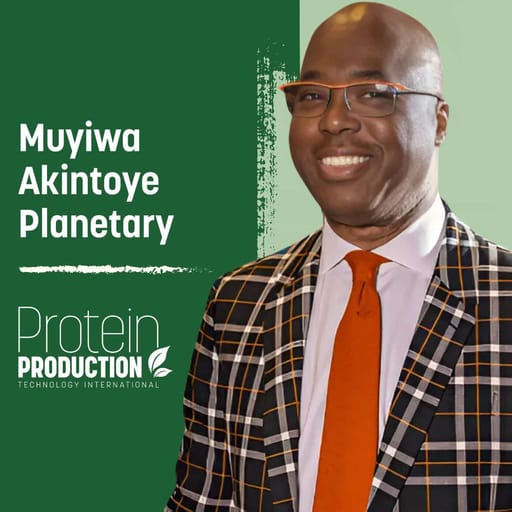
Transcript 0:00 [upbeat music] Welcome to the Protein Production Technology International Podcast. We explore the latest advancements in alternative proteins, from cultured meats to plant-based proteins. 0:11 We talk to experts and innovators who are working towards a more sustainable, efficient, and kind protein system. Join us as we dive into the exciting possibilities of the alternative protein industry. Okay. 0:25 Right now I'm joined by Dr. Moiwa Akintoye. He's the Chief Product Officer of Planetary. 0:30 Um, Moiwa has been at the forefront of developing mycoprotein-based foods that don't just deliver on sustainability, but also on taste and texture, um, the things consumers really care about when deciding whether or not to make these proteins part of their diet. 0:44 It's great to have you with us. Oh, thank you. It's good to be here. 0:48 Now, to kick things off, could you give us a, a quick outline of your role as Chief Product Officer at Planetary and how considerations like flavor and texture shape your priorities in product development? Okay. 1:00 That's absolutely fine. So I look after anything related to product at Planetary, and there's two parts to that. 1:09 The first part is the actual mycoprotein that we make, so we need to ensure that the mycoprotein meets the spec, both for our customers, but more importantly for the consumers of the product. 1:21 So Planetary is currently set up as a B2B player, so our intention is to make products or mycoprotein raw, what I would call raw mycoprotein- Mm-hmm... that other companies can then convert to food. 1:34 So I hasten to add, as many people will know, that mycoprotein itself is not food. It's just a raw material that enables us to create food. 1:43 So all the attributes of the raw mycoprotein need to deliver in terms of ensuring that the food quality that the consumers ultimately get is, is top-notch. 1:54 So my role is to ensure that we deliver that raw mycoprotein to the highest, uh, spec possible. 2:01 But I also have considerable experience in actual product development, foods development, and, uh, have spent many years tinkering around with mycoprotein. 2:11 Mycoprotein of itself is a key ingredient, but it only works when you combine it with, with other things, binders, flavors, and some other raw materials that then bring the mycoprotein to life as a dish- Mm-hmm... 2:24 or a food that customers get. So both of those go hand in hand. The other bit that I would add is the process of converting mycoprotein into food is also critical. 2:35 You can't really divorce it from the, uh, raw materials that you put together. 2:40 So both the raw materials and the processing, uh, processing steps that are involved help to create high-quality mycoprotein-based food products. Mm-hmm. Now when we look- And throughout this discussion- Pardon. 2:53 Sorry, I was gonna say I would distinguish between raw mycoprotein and mycoprotein-based foods. Great. Now, when we look at consumer adoption, nutrition is important, but ultimately people buy with their taste buds. 3:06 So from your perspective, um, what are the biggest consumer-driven challenges in making mycoproteins not just nutritious, but also, uh, delicious and texturally appealing? 3:16 The key thing to think about is how the mycoprotein actually grows. Now, as, as an organism that grows, it basically consumes sugar, 3:25 um, or carbohydrate, I should say, to, to use a better term, and then as it consumes this carbohydrate, it grows and produces what we call biomass. So it's the actual organism itself that, that becomes the mycoprotein. 3:40 Like everything in life, you are what you eat, so the mycoprotein or the, the, the fungus that produces the mycoprotein very much depends on what it's fed. 3:51 So if you give it the right ingredients, then it will grow nicely and give you relatively innocuous taste. 3:58 If you feed it with, uh, with raw materials that have a specific characteristic, the fungus will imbibe that, and that will be implicated in the final product. Mm-hmm. 4:10 So at Planetary, as with many other mycoprotein producers, what we need to do is to ensure that we give it the right kind of materials that allow it to grow profusely without significantly imbibing off tastes and off flavors from the environment in which it's growing. 4:26 So we, we keep it simple, and I'm sure many other mycoprotein manufacturers will tell you the same. We give it a carbohydrate source, which is critical. We give it a nitrogen source. 4:36 Without nitrogen, it cannot produce the protein. And we give it some minerals and vitamins like we all need. 4:43 Um, it, it's a living organism, and as long as you give it all the things it needs, it will grow pretty much as you expect it to. 4:51 And it's, it's a judicious selection of these ingredients, you know, knowing what it needs to grow fast and knowing what it will imbibe that may impact on taste. 5:01 It's a judicious selection of these ingredients that allow us to produce relatively bland mycoprotein that can be useful for, uh, consumer-facing products. Mm-hmm. 5:11 Now, mycoproteins, they naturally come with their own sensory profile, which can be a blessing, I guess, or a challenge, depending on the application. 5:18 H-how do you decide whether to neutralize those inherent notes or lean into them, for example, to enhance umami depth? Yes. With the umami or savory-type products, mycoprotein actually lends itself very well to that. 5:32 Its natural kind of taste is savory, as you've rightly mentioned, so you have a, a, a base savory umami taste. 5:39 If we get that right, which many, uh, people work to get it right, then it actually enhances the overall taste if you're making meat-type products. Mm-hmm. 5:47 So when you look at things like sausages, burgers, chicken-style products particularly, the white meat-type applications, good quality mycoprotein that has a light savory flavor actually lends itself very wellInto these kind of product, which means you, when you add flavoring systems to it, you don't have to go too far. 6:10 Very clearly you can just use seasonings, so typically salts, yeast extracts, and some basic seasonings like onion powder, garlic powder. Those kind of things enhance the natural savory character of the products. 6:24 Of course, you can go one step further by actually working with flavor companies to develop seasonings specifically to move the product in a particular direction. Uh, and that works well too. 6:35 You can enhance the natural tasting savory notes that are present in mycoprotein. Mm-hmm. Particularly if it's been processed properly. Now off-flavors, they're often a sticking point when it comes to microbial proteins. 6:50 From your experience, what strategies, whether that's, uh, strain selection or fermentation control or even DSP, have proven most effective at mitigating those unwanted notes? There's a, there's a number of things. 7:02 Um, obviously, if the fermentation process is abused or not strictly controlled, yes, the organism will pick up off-notes or create its own off-notes in trying to survive, as it were. 7:16 So we have what we call within Planetary our bioblocks technology, which obviously I won't go into great detail about, which enables us to profile the fermentation system, and that includes media selection- Mm-hmm... 7:32 uh, components of the media. Strain selection, you are right, is also important. 7:36 I mean, it's no secret that at the moment, uh, Planetary is using Fusarium venenatum, which is a, a kind of standard strain in the industry. 7:45 But we are also as a company working on other strains in the background that have different physical and chemical characteristics to Fusarium. 7:55 And of course, as we learn more and more about these other strains, we can tailor the physical characteristics, and that's both flavor and texture, to the directions that we want. Mm-hmm. 8:08 Having said that, you can also control it by how you select your media. 8:13 So we have, um, a lot of, uh, scientists in the background are beavering away working on media formulation, which also allows us to move the products, both texture and flavor, in the specific directions that we want. 8:27 So for instance, we can talk about things like longer hyphae, different colored material, material that's a little bit more pasty, material that's a little bit shorter in texture. Mm-hmm. 8:37 Those kind of things can be achieved by what we call our bioblocks technology, which is well known within the, the Planetary system. So- Mm-hmm... 8:46 that, that's kind of what we do, um, is just moving things in, in a different direction. I always compare it to a, a, a chef who's working in the kitchen, 8:55 and they can modify their recipe to move things in certain directions. I mean, the very simple ways of doing it are what spices do you use in the kitchen? What amount of salt do you use? Do you add chili? 9:07 Do you add black pepper? It's those kind of simple things. Not that we will use that, of course, in the fermentation. I'm just using that as an analogy- Mm-hmm... 9:15 to show that also chefs can move flavors and textures in different direction by selection of ingredients and process conditions, cooking, baking, steaming. We do the same pretty much. Mm-hmm. 9:27 Obviously at an industrial scale, not- Not, not in your kitchen [laughs]. Right. Essentially. Now clean label expectations, they, um, they make this even trickier. 9:37 So consumers don't want to see things like masking agents or, or additives. So how do you strike that balance between, um, technical reality at scale and the demand for simpler, more natural solutions? Yeah. 9:49 It's always a, a, a balance really. It's kind of a tricky balance because, yes, sometimes you may need to use masking agents and, you know, on a personal note, I don't have a problem with masking agents. 10:00 Some of them can be natural, um, and mo-most definitely safe. You know, no company will knowingly use an unsafe ingredient. So all of these things would've been tested. 10:09 So I personally don't have a problem with masking agents. I know some consumers do. 10:14 But you can have these natural components built into a flavor system whereby if you're using added flavors, you can kind of knock out or some of these rough edges. 10:25 Now, again, think about a, a chef in a kitchen who has an ingredient or a product that they want to make. In order to make it tasty, they will use added ingredients, as I said, salt, pepper, spices. 10:38 It's pretty much the same within what Planetary do. So yes, we may use some, um, added flavors in our finished products, but in our raw mycoprotein there is no flavor there, and there are no masking agents. 10:52 And by a judicious use and selection of our media, we can create very bland tasting mycoprotein where inherently we don't need masking agents. Mm-hmm. It feels like every category has, has had to wrestle with, um, 11:08 various challenges in some way, from plant proteins to dairy alternatives. Are there particular learning, learnings from those spaces that have shaped your approach to flavor optimization in, in mycoproteins? 11:19 Well, yes, there are. As I said earlier on, um, mycoprotein has its own natural flavoring system, which works generally very well with meat type applications. 11:29 But of course, mycoprotein does not need to be limited to savory applications. There are a number of developments already in the market and being and still in development within many countries moving away from just meat. 11:44 So looking at things on the dairy side, for instance, cheese, milk, yogurts, those sort of things are a completely different ballgame to what you would do with savory. Yeah. 11:54 So how do you move a naturally savory tasting product into these kind of, what I would call more bland or sweet applications? 12:03 Yes, there are some downstream processes that need to be applied to the-Microprotein biomass that will enable you to make it bland. 12:12 And it involves, um, using physical processes to try and reduce, sometimes maybe even completely eliminate these savory notes. Having said that, maybe I'll retract a bit. 12:24 Um, you probably can't completely eliminate it, but you can reduce them to a level where they are so low as to be imperceptible. Mm-hmm. 12:32 And of course, when you look at the kind of applications that I've just talked about there in dairy, there's a lot of water and acids involved, um, in those products naturally. 12:41 And these kind of acids, especially the natural acids that form, have a very good and important role in reducing, and sometimes even eliminating these savory notes- Mm-hmm... 12:52 so that you get a, a very bland, natural-tasting dairy-type application. Now, if flavor is half the equation, texture arguably is the other half. Mm-hmm. 13:03 Consumers, they want that fibrousness or bite that they associate with animal protein. So how do you go about engineering mycoprotein textures to replicate those, um, qualities? Yes. 13:13 So think about the mycoprotein basically as a long-- as a fiber, a physical fiber. Under the microscope, it actually looks like jumbled up spaghetti. Mm-hmm. 13:23 So what we and many other companies do, of course, is try and align those fibers so that you get the meaty characteristic. So two things come into play here. 13:32 One is, how do we grow the mycoprotein so we can get these long fibers? And it's always going to be a balance between how long the fibers are and how fast you can grow the mycoprotein. 13:44 And they tend to be inversely, uh, correlated to each other. So usually, the rule of thumb is that the faster the mycoprotein grows, which gives you better yield, generally, the shorter the fibers are. 13:56 So depending on what the application is that we want it to be, we can control, to a reasonable degree, the fiber length of the mycoprotein that we make. Mm-hmm. 14:07 So that's-- that, that gives us a good head start in how we get these fibers. The second thing to do is then to find a way to align those fibers such that you get these thick bundles, um, of a meat-like structure. 14:22 And that is, of course, where the downstream processing and recipe formulation comes in. So by use of binders a-and other food ingredients like starches, um, 14:33 like textured vegetable protein, um, of different types, or, you know, the addition of certain chemicals will make the mycoprotein kind of bind to itself. 14:44 And the more you can create these thicker bundles, the closer the product is to meat. Mm-hmm. 14:50 Of course, the trick is to try and do this in a natural way without, um, one million ingredients in your recipe, and also looking at the different types of downstream technology that allow you to convert a pasty mycoprotein into a fibrous structure. 15:09 Mm-hmm. And there are different ways of doing that. There's, um, there's a lot of focus on myoproteins as a meat analog ingredient, but they obviously have potential, um, beyond that. 15:19 Do you see applications in other niches like seafood or dairy or even bakery? Yes, certainly. Um, over the years, I've actually been fortunate enough to be involved in many of these applications. 15:32 Um, obviously, very few of them have actually hit the market. But yes is a simple answer to your question. 15:38 By looking at what I described earlier on, different fiber lengths, different fiber structure, and further downstream processes, yes. You can look into things like creating dry powders, for instance. Or powders. 15:51 Most powders are dry. [laughs] You can look into creating powders that then can be used in other applications. 15:56 So in my, um, role, um, not just within Planetary, but in previous jobs working with mycoprotein, we've looked at a whole range of things. So snacks, expanded snacks, breakfast cereals, pasta, soups, bread, cakes. 16:12 All those sorts of things are things that you can certainly apply mycoprotein to. Mm-hmm. The challenge, of course, is how do you get the mycoprotein in there without bringing the savory taste? 16:22 Because, of course, as you concentrate the mycoprotein, you also concentrate the taste. 16:27 So there is still a gap between where you would like to be in terms of how much mycoprotein you can physically put into these type of products and how you actually get there. 16:38 The other thing to point out is with a number of these kind of products, because mycoprotein itself doesn't necessarily have the functionality of some of the kind of things that we've just talked about, um, there is a natural limit as to how much mycoprotein you can add into these ingredients, particularly if you're looking at it from a protein fortification point of view. 17:00 Mm-hmm. And I'll give you a very good example, which hopefully many of your, um, listeners will understand. If you look at bread, the key active ingredient in bread is wheat gluten. 17:11 And the stronger the gluten, generally, the stronger the bread. Mycoprotein, of course, in these kind of bakery applications can be used, but mycoprotein is not gluten. It will not replace gluten. 17:22 So if you're going to put mycoprotein into bread, as an example, or a cake, as another example, then we have to kind of work along with the wheat gluten in order to achieve that. And so that's just one example. 17:35 But if you look at across the range of all the other products that I just mentioned, you would find similar challenges, sometimes limitations in that area. Mm-hmm. But they can be done. Um... Yeah. 17:47 A-and when you think of myoproteins as a, as an ingredient platform rather than just a single product, what kinds of new applications or product formats, um, excite you the most right now? 17:57 Um, I would say we are doing quite a lot of work in the dairy side of things. 18:03 Um, it's always been the case that if you want a very good dai-- uh, uh, cheese product, for example, or a yogurt, most of the time you start with milk. 18:14 Of course, with soy-Um, which is the other key ingredient that goes into a lot of these kind of non-milk. I'm sort of trying not to say vegan, but maybe vegan is the right word to use here. Mm-hmm. 18:26 You invariably have to use things like soy or pea. They come with their own challenges. 18:32 They carry a much higher carbon footprint than mycoprotein does, and of course, there is a taste issue in trying to extract this protein. 18:40 The good thing with mycoprotein in this area is that you don't actually have to physically extract the protein from the mycoprotein in order to get a good product. 18:48 You can use the whole product, and of course, it comes with fiber, which a lot of the protein isolates, in fact, none of the protein isolates can deliver fiber. 18:56 You have to add the fiber as an extra if you want a high-fiber product. Mm. With mycoprotein, you can do that, and that's one of the things that excites me. 19:04 So thinking about the kind of applications where you typically will not find high protein and high fiber together unless you assemble it. 19:12 You can do that with mycoprotein just by itself, as long as you get the right process conditions to, to do that. Mm. And I find that quite exciting because the sky's the limit in terms of what you can do in that area. 19:25 Um, we're only limited by the processes that we haven't yet developed or fully understood. Um, there's a wide scope there for bringing those things together, and so that, that gives me particular interest- Yeah... 19:38 and an area that I'm working on. 19:40 Now, looking ahead, if you had to imagine the holy grail, shall we say, of mycoprotein sensory experience in, say, five years' time, uh, what would that look like, and, and how close do you think we are to getting there? 19:51 Um, the, the big challenge that we still face, I would say, is trying to get mycoprotein to a higher protein content. 20:03 Mycoprotein naturally only has about between eleven and thirteen percent in, in, in its natural state, um, as a wet ingredient. 20:13 Of course, when you take the water out and de-water it, uh, by drying, we can get to about forty to fifty percent protein. 20:23 I'd kind of like to see other strains that are able to produce more protein per, per gram or that we can engineer the strains in a natural way to encourage them or make them produce even more protein. 20:38 'Cause what that would do is it would bring the cost down per unit of protein. 20:43 And of course, for me, that's an area, particularly in other countries or other parts of the world where protein consumption still remains an issue, that we can get relatively inexperienced... 20:55 inexpensive rather, not inexperienced, inexpensive protein, uh, by using typical fermentation methods. Most, most fungi, particularly fusarium, grows very fast if you give it the right conditions. 21:08 So if we can make it produce even more protein per unit, um, kilogram of media, for me, that would be a great place to be. And I think in five years' time, 21:17 hopefully before that, we will start to see a move in that direction. The other thing I would say is the infrastructure for making mycoprotein currently is very high, uh, very... well, it's very high. 21:29 You need scale in order to be able to make mycoprotein more efficiently. 21:34 I would like to see, and I think we will get there in, I would say, five to 10 years' time, where you don't need such heavy infrastructure to make mycoprotein, and it can be made relatively cheaply with very little capital. 21:48 That would be a great place to be, and I know there's- Mm-hmm... a, a number of, uh, technologies that are being redefined and redeveloped to get fermentation to be even more cost-effective. Hmm. 22:00 Well, we're seeing, um, exciting progress in areas like strain engineering, which you talked about, and precision fermentation. Mm-hmm. 22:06 Is there any way that you see those advances complementing biomass myoproteins inter- in terms of delivering even better flavor or texture? I, I do. 22:15 Um, obviously in Europe, precision fermentation is still a challenge from a regulatory point of view. Mm. Um, but yes, you know, I, I see it as only good things. 22:26 Obviously other protections need to be in place that we don't create what is perceived or stated as Frankenstein foods or Frankenstein products. That's not what it's about. 22:36 But with judicious use of the technology that currently is available, I see that as only a good thing. And when you look in the pharma side, um, of precision fermentation, it's already having great benefits. 22:50 Insulin is probably the biggest example of that. Hmm. Production is now done mostly by precision fermentation, and, you know, there's no reason why that industry or that technology can't be advanced even further. 23:04 I think it's just a matter of time. Mm-hmm. Now, few people, I would imagine, in the world have been working with myoproteins for as long as you have. 23:11 If you had to distill it down to one key insight, um, the single most important lesson you've learned about making proteins, um, truly consumer-ready, what would that be? I would say don't underestimate the customer. 23:24 I've made this mistake a number of times, um, where we have developed products that I just kept saying, "Oh, no, they're not good enough. They're not good enough," and we just keep working at it and working at it. 23:35 And, um, I remember one of my previous bosses used to say to me that good is the enemy of bad, as it were. 23:44 So sometimes you just have to go with what's good enough, and I found that to be the case where we have eventually launched products and I've been completely blown away by the reception to those products because customers are basically gagging for these kind of products. 24:04 And in trying to make them as good as we possibly can, which is a good place to be, sometimes we just go too far. So for me, the biggest insight in this area is thinking of what your customers need. 24:19 Maybe they're not quite as sophisticated as us product developers in terms of what we think the customer wants. Mm-hmm. 24:24 The customer actually knows what they want, and they know when they get it that if it appeals to them, they will go with it. So sometimes we probably just need to stop at a certain point, 24:37 do our due diligence, of course, that's critical, but ensure that we're not trying to push a Rolls-Royce, uh, to the customers when actually what they want is a BMW. Something like that. I hope that analogy works. 24:53 [laughs] It works for me. Look, Mwiwa, thank you very much for joining me today. 24:57 Uh, it's been great to hear how you're approaching, um, the sensory side of myoproteins and how Planetary is working to make these ingredients, uh, not only sustainable but genuinely enjoyable for consumers. 25:07 Really appreciate your time today. Thank you. Thank you very much. Thanks for having me. [upbeat music] Thank you for listening to the Protein Production Technology International Podcast. 25:16 We hope you gained valuable insights and knowledge about the innovative technologies and practices transforming how we produce protein. 25:23 Don't forget to subscribe to PPTI Magazine and follow us on social media to stay up to date with the latest news and updates. Stay tuned for more exciting episodes.