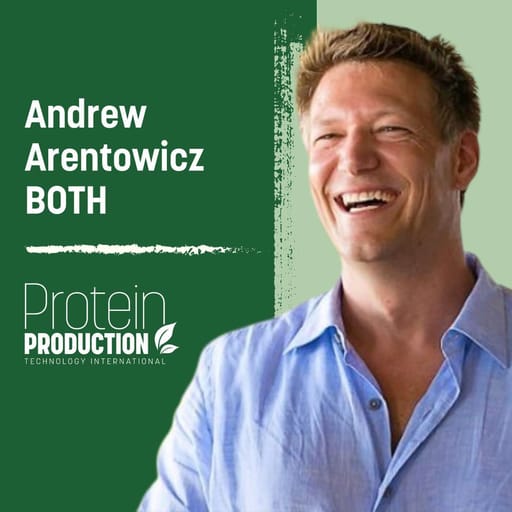
Transcript 0:00 [upbeat music] Welcome to the Future of Protein Production podcast. In this series, we will explore the technological advancements that are shaping alternative proteins. 0:10 From cultured meats to plant-based proteins, we will talk to experts and innovators who are working towards a more sustainable, efficient, and kind protein production system. 0:20 Join us as we dive into the exciting possibilities and challenges of the alternative protein production industry in the years to come. [upbeat music] Welcome to this Protein Production Technology International exclusive. 0:36 We're really pleased to be speaking with Drew Erensevich. He's the CEO and co-founder of Fifty Fifty Foods, which produces a product called Both. Thanks for getting up early and joining us, Drew. 0:45 Thank you for having me, Nick. A pleasure to be here. First things first. Now, how did the idea for a burger that has 50% meat and 50% vegetables come about? 0:53 Can you take us through the process of developing that product? A-and to your knowledge, are there many others taking this approach? Yeah. Thanks, Nick. Um, so first and foremost, we are... 1:02 w-we're in the blended space, so there are other companies doing some type of blended burger- Mm-hmm... um, or blended product. 1:09 Uh, we are the first and only USDA-approved 50/50 burger, so, um, it's basically one and only. Mm-hmm. 1:18 And for us, we feel like the simplicity of cutting meat consumption in half is the, the, the, you know, the genius of the product. The simplicity is the genius. 1:29 Um, it's easy for people to understand the what, 50/50, and understand the why, I'm cutting meat consumption in half, and that's very important. Mm-hmm. So we, we... This idea came about, ah, 2019-ish, I guess. 1:43 Um, it was really the, the, the inspiration was when the, um, Amazon, the Brazilian rainforests were being razed for cattle production. Um, I think that was probably late 2018. 1:56 But, um, something like 40% of tropical forests in that region have been taken down for cattle production, and I was thinking- Mm-hmm... this is unsustainable. What are we doing? And it kinda hit me at, 2:10 at, at, at the exact wrong time that Impossible, Beyond, that these companies were, um, they're a fad, and people w- it was impossible to assume that everybody was gonna turn into a vegetarian. 2:23 And I come from the school of it's-all-hands-on-deck time. We need to ha- you know, we need to do everything possible to reverse the effects of human-made climate change. Mm-hmm. 2:34 And so I wanted to make it easy for people to make a change. I wanted to lower the bar for consumer conversion and allow people to have their meat and eat it, too. So that was the original idea. 2:45 We got to work in the kitchen. Obviously, for us, um, we lead with taste, so we take flavor-enhancing toppings like roasted mushrooms, caramelized onions, roasted garlic, and we put those inside the burger. 2:57 So things you normally associate with making meat taste better, we put inside the burger so that there's no sacrifice. So we look at this as more of a celebration that you get to have your meat and eat it, too. Mm-hmm. 3:07 Now, just interested, what's your own career path? So h- it's... I, I've, I've always wanted to be an entrepreneur. I've always wanted to start something on my own. 3:15 So I had a c- a couple of companies that I started y-years ago that, that had varying degrees of success. 3:22 Um, and, and most recently, I was working with a, um, with a brand licensing company called Global Icons, and we... You know, our clients were, like, Ford. So if you saw a Ford Mustang on a T-shirt, Ford didn't do that. 3:36 We did that. Um- Okay... and we also have... We do a lot of food licensing. So I had exposure to food, and, um, my CEO, he came from, uh, his family came from meat and a meat background. So I knew I had... 3:50 I knew what I didn't know, but I knew I had the right, um, the right connections to kinda fill in the blanks, and I was able to, um, I was able to, you know, reach out to my connections in the meat world and, and, and fill in those gaps as I started this business. 4:09 Mm-hmm. Now, this is a bit of a personal question, Drew. Yeah. I mean, how would you de-describe yourself in terms of your, um, dietary preferences? Um, so, y-you know, I, um... This is a, a longer story. 4:21 Um, I, I did a body fat loss challenge in, uh, 2017, 2018 against 30 other dudes- Mm-hmm... and, um, it was basically who could lose the most body fat in- Right... 70 days. 4:35 And up until that point, I had eaten everything. I drank everything. 4:39 Um, according to my wife, I was starting to look a little bit chubbier than normal, um, and I didn't realize that, like, there was a way to be health- more healthful. Um, I just- Yeah... I took my health for granted. 4:52 And I went through this challenge with these 30 guys, and, um, in a lot of ways it changed my life. And ever since then, I've really taken health seriously and have... I w- I would probably consider myself, um, 5:07 more paleo. I wouldn't say keto, but more paleo, so lots of fruits, vegetables, protein. 5:14 But, you know, oats and, you know, a- and some pasta, some bread, some carbs, but low carb, high protein, high vegetable, high fruit diet. Mm-hmm. Now, let's, um, start. 5:24 I mean, you've mentioned, um, hybrids and mentioned blended. Let's start off with that name, which I guess is key. 5:28 How do you define or how should we distinguish between hybrid and blended, and do you, in fact, like either name? Um- Yeah... I guess. Um, I mean, I mean, it's, it's as simple as can be. 5:37 It's anything that you take meat and you mix with vegetables. Um, I do not like either one of those terms. I'm not sure who came up with either one of them. Hybrid obviously reminds me of the Prius. Mm-hmm. 5:47 Blended reminds me of a smoothie. So I don't really like either one of those names, and as a leader in this space, I would like to think we can come up with something better. Mm-hmm. 5:58 Um, I don't know if that's meat plus or flex meat or enhanced meat. I, I, I don't actually have the answer. 6:05 Um, and I'm not, I, I-I, I'm not actually even convinced that there is an answer and if there's not, then I think we just gotta pick one and roll with it and, you know, repeat it 10,000 times, and eventually that'll just ma- it, it'll change my perception of the word 6:20 H- how important is it that we get that terminology right? I mean, we're, we're calling cultivated meat cultured meat, we're calling it lab-grown meat, we're calling it cell- Yeah... cultivated. 6:28 So it's interesting you ask that question 'cause I, I, I spent some time with, um, the woman who was hired to come up with the word cultivated meat, so that whole industry wants you to say cultivated. 6:40 They don't want cultured, they don't want lab synthesized, they don't want cell-based, they want cultivated meat. 6:45 So that was a couple, you know, t- tens of thousands, $100,000 study to find out what's the best term for this lab-grown meat. Mm-hmm. 6:54 And they came up with cultivated, but what they realized was none of the options were really that good. Mm-hmm. That was just the best of all of the options. Yeah. 7:02 And I'm, I'm, I'm worried that we're in that same dynamic with blended meats, that I don't, I haven't found something and I haven't heard anything that would really, you know, make it resonate. 7:14 Um, I haven't spent the money yet. 7:16 Um, i- i- if you know any venture capitalists who want to, um, spend that money for us, uh, we, we, I, I think, I think that, I think that market research needs to be done by some so- relatively sophisticated people, not just me in an armchair. 7:30 Um- Yeah... but I, I, I think if I were having to choose, I'd probably choose hybrid over blended, but we'll see. We'll see. 7:38 I, I, I know that, I know that this is, this is something that's being discussed in our, um, in our industry, and we'll see where we land. Mm-hmm. 7:46 Um, many of the other interviews, uh, in this article, they're focusing on hybrid blended products that combine, um, cultivated or fermentation-derived ingredients with plant-based. Mm-hmm. 7:55 Um, you've opted for a different approach. You're using conventional meat with plants or vegetables. Um, moving on to that product now, what specific types of meat and vegetables are used in both? 8:04 Um, we are technically beef agnostic, so we can use any beef. Um, in our retail package, we are using grass-fed beef. In- Mm-hmm... um, food service, we have some just pretty basic regular beef that we're using. 8:17 Um, we are now also, we have another client who wants USA Angus chuck. So whatever a client wants, we can use. We're, we're... 8:25 An- another, um, high-end retailer has asked us for GAP4 beef, which is high-end grass-fed beef. Um, so we're beef agnostic and, and, and the fact of the matter is, uh, cutting any beef in half is actually good for us. 8:39 Yeah. So, um, yeah. So we're trying to keep this as a premium high-end product, which I believe that it is. Um, but, uh, yeah, it doesn't, the beef doesn't matter. 8:49 For our vegetables, it's mushrooms, carm- uh, roasted mushrooms, caramelized onions, um, broccoli, cauliflower, and roasted garlic, and a little bit of seasoning, which is basically a little bit of salt, onion powder, garlic powder. 9:03 Mm-hmm. So not too many ingredients in there and very natural- Super clean... ingredients as well. Yeah, it's about as clean of an ingredient profile as you're ever gonna see in, in the food industry. Mm-hmm. Yeah. 9:11 N- now, we know that taste is everything to consumers. We're seeing this in the plant-based sector especially. Um, how do you ensure that balance in taste, texture, and nutritional value? 9:20 We're gonna talk about nutrition later. Sure. But how do you ensure those things with a 50/50 ratio? And, and does both compare in taste and texture to- Sure... traditional meat only or vegetarian burgers? 9:29 Um, uh, we are, w- uh, we compete with beef. We do not compete with processed plant. Mm-hmm. So my competition is beef. Um- Mm-hmm... 9:38 and, and frankly, w- why do people put roasted mushrooms and caramelized onions on top of their beef burgers? Does it make them taste better or worse? Yeah. It's, it's very simple. 9:48 So the, our, our entire, our entire company is really about simplicity. So we put things that make meat taste better inside the burger. So it actually... I mean, consumer feedback is fantastic. People love our burgers. 9:59 It has a very similar mouth feel. Most people don't believe us that it only has six ingredients or that it's half meat, half veggie. If you saw the product, you probably wouldn't believe me. 10:09 The only way that you'd believe me, if you were on the manufacturing floor and watching me do this. Um, so it's kind of... O- our process of how we do this is really our secret sauce. 10:19 Um, without any additives or binders or, or, or soy protein, pea protein, any of that nonsense that, um, goes in some of these other products. 10:28 Super clean ingredients, ingredients that taste great, are healthful, simple, transparent. You know, we check every box. Mm-hmm. Now, consumers are king. 10:38 Everybody needs to get consumer buy-in for a new product or a new category. At the same time, consumers will say one thing, "I, I want to eat more healthfully," or, "I want- Yeah... 10:46 cleaner ingredients," for example, and yet do another. They buy a 16-ounce rib eye for dinner. So how do you navigate that dissonant psychological landscape? Yeah. Um, it, it, it's tricky. 10:55 You know, that's the short answer, it's tricky. And I, I, the way that we navigate it is I think you need to start with your core consumer. You know, who, who understands this immediately? 11:05 And those are flexitarians, those are paleo-friendly people, moms who understand getting their kids to eat more vegetables is important. So we need to stick with our core affinity groups. Mm-hmm. 11:16 And as long as we start there and kinda grow out, I think we will, it, it, it, it'll, it'll, it'll create the flywheel of understanding and, and consumer conversion that we're looking for. 11:27 But if you just were to drop into Kentucky and ask some random person who has never eaten a vegetable in their life, "Hey, you wanna eat a 50/50 burger?" That's probably not the best place to start. 11:39 But I do think, um, it, it's, it's not, it, it's... 11:43 A- anyone in this country, any part, any state, anywhere, there's, there's an acknowledgement that eating too much meat is either not good for your health, whether it's cholesterol or whatever, it's not good for the environment. 11:55 Um, so it's not a work... This isn't, this isn't rocket science here. Most people understand the why, and people have different whys, but most people understand the why. 12:08 In terms of getting people to that psychological dissonance that you're talking about, we lead with tasteThat's how we do it. You lead with taste. 12:16 This isn't a product that is asking you to sacrifice and asking you to do something that you don't want to do, um, in order to accomplish some goal that may or may not be possible to accomplish. 12:28 We have a great tasting product and- Totally... you'll love it. Oh, oh, and by the way, it has all these other added benefits. That's how we do it. 12:36 Well, we're gonna talk about some of those added benefits as well, but what feedback have you received from customers, um, regarding taste, texture, and overall satisfaction? 12:43 And then what steps did you take to ensure those, um, criteria? I mean, almost universally people love it. The, it, that's just the truth. So there's- Mm-hmm... there, there's not a lot of... 12:54 W- we've got a great product, you know, that's, that's, that's the best thing about what we're doing is the product speaks for itself. Mm-hmm. So, you know, I, I don't have... 13:03 I, I can't give you data because it's all, you know, it's all qualitative in terms of feedback from people who have tried it at, at restaurants, people who have bought it at, at, at, at our retail locations, friends who come over and have it. 13:16 Um, and, and, you know, but I probably have an informal data set of hundreds, maybe a thousand data points, and it's pretty universal. People love the product. 13:28 Well, I'm guessing that there's no reason for people not to like it. I mean, it's not much different than, you know, well, certainly my grandmother's meatballs [chuckles] she used to make as- Yeah... when I was a kid. 13:38 Yeah. Yeah, totally. Yeah. M- mixing meat with veggies isn't a novel concept. Mm-hmm. And in a lot of ways, I believe that vegetables make meat taste better. You know? Mm-hmm. There's a flavor profile. 13:48 There's a, you know, there's, there, there's the mouth feel. You know, there's a reason why there's beef and broccoli, right? Like, there's... This isn't, this isn't a novel concept. 13:57 We're just, we're trying to create a product to make it easy for people to either eat less meat if they want to eat less meat, in a product that makes them feel good, um, doesn't ask the impossible, and also has all these added health and environmental benefits. 14:12 So we're just- Mm-hmm... trying to make it easy for people to make a difference. Let's talk about some of those benefits now, Drew. 14:18 Um, in terms of nutrition, what, uh, advantages does Both offer compared to a conventional burger? Ah, lower cholesterol, lower fat, um, and it, and, and even some of the, like, processed plant. 14:30 You know, they've got, whether it's pea protein, soy proteins, nut oils, a ton of sodium. 14:36 If you look at the sodium content on an Impossible or Beyond, it's like 20, 30% of your, of your daily recommended amou- uh, sodium content for the day. Um, for us it's, like, 2%, 3%. So... And then obviously it... 14:53 Talk to a nutritionist about the value, you know, the, the nutritional value of mushrooms, the nutritional value of broccoli, the nutritional value of garlic, the nutritional value of cauliflower. 15:03 You know, there's, these are, these are nutrient dense, um, foods that you don't even realize that you're eating. Mm-hmm. 15:12 So in what ways does that 50/50 composition contribute to sustainability or reduced environmental impacts? I mean, can you elaborate on any of the environmental benefits of producing that burger that you do there? Yeah. 15:24 So there's... O- obviously, the lowest hanging fruit in the food business in terms of carbon and water is beef. 15:31 It's the, it's the most carbon intensive food product that we eat by a long shot, you know, it's not even close, um, in terms of volume and impact. So, um, I'll, I'll, I'll make it personal. 15:43 Um, I live in Los Angeles and Los Angeles, Las Vegas, San Diego, um, Phoenix, all of our water comes from the Colorado River. Mm-hmm. And the Colorado River is under tremendous amount of stress right now. 15:58 There are two reservoirs that feed all of those cities, Lake Mead, Lake Powell. They are... Some experts give Lake Mead and Lake Powell eight to 10 years before they reach deadpool if we don't make a change. Mm-hmm. 16:14 So imagine everybody in Los Angeles, San Diego, Las Vegas, Phoenix wakes up one day and the pipe where the Lake Powell and Lake Mead are resting doesn't produce any water. Mm-hmm. 16:29 So you're talking about residentially, we only use 12% of that total, of, of the total water usage. Mm-hmm. The other 88% is industrial and agriculture. 16:46 55% of the total, 55% of the total goes to two products, alfalfa and grass, hay for cows. Right. So 55% of all water in the West goes to cow food. 17:05 So if you wanna start somewhere, if you want to actually have an impact, you need to figure out how do you get Americans to give up their burgers? And I'm not saying give it up like you gotta stop eating your burgers. 17:19 It's how do you, how do you persuade them to do something that they don't wanna do? And Impossible and Beyond, all these plant burgers have already failed. 17:29 Cultivated meat, God bless 'em, maybe you'll make a dollar in 2050. Mm-hmm. Or may... How are you gonna convince people that you're eating real meat or whatever? I, I... 17:40 The, the, the cultivated meat, I, I'm, I'm not against anything, I'm for everything, but you ask people about... You ask people now about cell-based meat, what they feel, their first response is disgust. Mm-hmm. 17:53 So that's quite the hurdle. For us, we have no hurdle. You get to eat meat. We're still letting you eat meat. Oh, and by the way, it's also delicious and healthful. Mm-hmm. 18:03 So we are t- we're talking about a product that people understand what it is. It's real meat, real vegetables, really healthy, does... 18:13 Actually achieves the goal that we're trying to achieve, which is continue to be able to live in the West-And we do so economically. A pound of our vegetable base costs less than a pound of beef Mm-hmm. 18:26 So with plant-based, you're talking about Impossible and beyond, it still costs a buck sixty for every dollar in sales. You're talking cell-based meat, two hundred dollars a pound. 18:39 You know, this, the, these, these are fantasies. We actually have a real business with a real product that people really like, and it solves a problem. Hmm. 18:48 I mean, with food, and we're seeing this, um, especially now at COP twenty-two, uh, twenty-eight, sorry, um, there's always a big focus on carbon emissions. 18:55 And I understand, you know, water is a lot more tangible, isn't it, for consumers to identify, especially where [chuckles] you are in California- Yeah... given the constraints that you've got. Yeah, totally. 19:04 I mean, look, o- obviously carbon is important too. Um, and kind of to your point that we were talking about earlier, you gotta get the name right. 19:11 Um, I think, I think the environmental movement shot themselves in the foot right out of the gates by calling it climate change. 19:17 You know, 'cause it gives your, it gives your opponents the ability to say, "Oh, well, the climate's always changing." So now you've lost 50% of the people, and now you've got an uphill battle. Um- Yeah... 19:25 it's not about climate change. It's about, it's about pollution. It's about cause and effect. 19:31 You can't tell me that you're gonna sit in your garage with your car on and think that you're gonna live if you put the windows down. No. There's things spewing out of the car that will kill you. 19:45 Now, multiply that by billions of cars every day, you can't tell me that that cause will have no effect. Mm-hmm. There w- there is an effect. Now, we can argue about, okay, well, what's the effect? 19:57 But you can't tell me there's no effect, that we live in an, in an alternate, you know, physical reality. There is a cause, there will be an effect. Mm-hmm. So I get the carbon argument. 20:07 And I, and we obviously need to do something about it. 20:09 Um, I do feel like we've shot ourselves in the foot calling it climate change, and I, you know, uh, similarly for our, our industry, I'd like to call it something that is positive and gets people excited. 20:20 And I don't know if blended and hybrid is that yet, but we'll see. Um, 20:25 but beef, in terms of, you know, methane gas, in terms of the, all of the inputs for beef, whether that's corn, alfalfa, all of these inputs, it's just a tremendous amount of carbon and a tremendous amount of water. 20:39 So we hit both. Now, where is your product currently available? And, um, are there any plans to expand its availability to new markets, um- Yeah... internationally, for instance? Uh, yeah. 20:51 I mean, look, our, our mission's every menu, every shelf. Mm-hmm. So I think... I, I want the fifty-fifty burger to be the third option everywhere, and I think consumers deserve to have it. 21:03 Um, and because right now we're asking... w- the, a full 100% plain beef burger obviously has its issues. I mean, I love to... I s- I love g- I love to eat meat. I'm one of those people, I love to eat meat. 21:14 I find it hard to... I would find it very difficult to become a vegetarian, so I actually made this product for myself. Mm-hmm. So I think this product needs to be everywhere and give people the option. 21:23 So right now, we are in, we're in five restaurants here in Los Angeles. We're about to launch, um, God willing, at Disneyland here in January. Um, we have, um... 21:31 we're, we're teed up for, um, a direct-to-consumer company called Thrive Market, which again, God willing, uh, Q1 we'll be launching with them. Uh, we are in 142 retail stores. 21:44 Um, we're in Raley's up in Northern California, and they have, um, a couple other, uh, brands called Nob Hill and Bel Air. Then we are also in ShopRite on the East Coast. 21:57 Hopefully, gonna expand, um, to more of their stores. And, and look, I, I, I want this everywhere, whether that's Walmart, Kroger, Albertsons, Whole Foods. I want this everywhere. Yeah. 22:09 And so we, right now we have, we have, with our two co-packers right now, we've got about 20 million pounds of capacity just with those two co-packers alone. Um, that could get us into Costco. 22:19 That could get us into Walmart. We've got a ton of capacity right now. Yeah. And how we- What, what, what I like about- Yeah. Sorry, go on. Go on. Yeah. So h- so how... 22:28 And how we do this, we can expand our capacity as we grow. This isn't, again, rocket science. Um, but, um, right now we're, we're, we're ready to roll, and I want this everywhere. Mm-hmm. 22:39 Yeah, what I like about your product is that you're not giving consumers an either/or. It's not plant-based- It's both... or meat. It's both. It's both. Hence the name- Yeah... obviously. Exactly, yeah. 22:47 And, um, there's a, there's a debate going on- We're both... there's a debate going on in our industry about the word alternative i- in terms of alternative proteins. You know- Yeah... 22:54 there should be complementary proteins, because- Yeah... the alternative proteins industry, even by 2050, it's not gonna take over the meat industry, and they just don't have the backing or the voice- Yeah... 23:04 to be able to fight Big Meat, as it were. Um, so yeah. Given- Yeah, and they- Given, given the best of both worlds. It's the best of both worlds. Um, in a world of either/or, why can't we have both? 23:14 Yeah, that's sort of the ethos of this company, and the ethos of our product is like, i- in this hyper-partisan world, can't we just meet in the middle and, and, and h- find a happy medium? 23:25 Um, there's, there's just a lot of, there's a lot of positivity around this product. Mm-hmm. 23:30 And, um, and, and I think, you know, just from the feedback that we've gotten from the consumers that have had it, again, no sacrifice. It's a celebration. You get to have your meat and eat it too. 23:39 Now, what would you say has been your biggest, um, challenge in developing the product, and, and how did you overcome that? 23:45 Um, the first one was, uh, how do you get a fifty-fifty burger to not fall apart without using additives and binders? So we had, our mandate was keep it clean. It's gotta be super clean. Um, so that was our first hurdle. 23:57 How do you do that? Um, and that's a much longer story. 24:01 Um, so overcoming that hurdle, uh, from, uh, on a commercial scale, 'cause you could probably do it in your kitchen, but even, even in your kitchen the thing starts to fall apart. So how... What, what are the ratios? 24:11 How do you do this? Um, that was the first hurdle. The second hurdle was the USDA. The USDA would not let me call this a 50% beef, 50% veggie burger.They're like, "Yeah, sorry." So how do you get... 24:25 You know, so now I can't sell my product or I can't tell consumers what it is. I could say 50% beef, but they wouldn't let me say what the other half was. And I was like, "Well, what am I supposed to do?" 24:34 They're like, "Not our problem." [laughs] So again, much longer story, but, you know, you're talking about in the US, the regulatory body of the USDA, 24:43 they have certain rules, and that does not include vegetables, you know? So it's, it, it was... That was... You know, that cost me, you know, ton of money and a ton of time, but I couldn't sell my product. 24:57 What do you do? So I had to basically turn into a lobbyist, um, and, and figure out a way. So that was, that was, that was big. 25:05 And so finally, through the appeals process, we were able to, um, persuade them to allow us to let us say what it is, what our, what our product is. Mm-hmm. Um, the third hurdle has been financing. 25:19 So we're, we're a bootstrap company. You know, it's been a lot of friends and family, but we're... 25:24 again, we're, we're, we're growing and, you know, just affording inventory and marketing, you know, it's expensive to do this. And you burn a lot of gas. When the airplane's taking off, that's when you burn the most gas. 25:36 And it's been, um, disheartening to see the venture world that is apparently made up with the smartest and most accomplished, most experienced people in the world, um, dump hundreds of millions, billions into cultivated meat and processed plant, and yet, um, they've never made a dollar, and they don't... 25:59 They're, they're not in... You know, I mean, p-processed plant is, is obviously i-in the market, but cultivated meat hardly is. And yet we have... We struggle to raise money, and it's like, "Oh, well, you're too early. 26:13 You're too early. You're too early." It's like, w-w-what are you talking about too early? Like, what about all these other investments that you made? Like, they're 10 years away from ever maybe making a dollar. 26:22 How is that not too early? So anyway, that... I, I think there's a tech bias in the venture world. Mm-hmm. Um, I think we're also in a, you know, th-this high interest rate environment, hyperinflation environment. 26:36 They just have, you know... It's, it's a buyer's market right now. So I think the food industry is getting hit because margins are shrinking because of inflation. 26:44 Um, I think these cultivated meat companies promised a lot, under-delivered. 26:49 Um, so the environment, the capital environment right now is treacherous, and, you know, but y- y-it's that which does not kill you makes you stronger, and I think there is a... 27:01 I, I look at it every day as the ability to figure out how to do more with less, and that's, that's part of the ethos of the company, right? Less is more. So I, I, I... It... 27:11 We're gonna prove it, and we're gonna get there, but I think we're just gonna have to work a little bit harder to get there. Mm-hmm. I mean, what's been your experience of attracting funding? 27:19 Um, you know, compare and contrast that when you started the company in sort of 2019 with today. Yeah. Uh, and, you know, given what you've just said about the VCs, um, 27:28 you know, preferring the sort of high-end food tech technologies, are we seeing double standards from the, from the VC community? 100%. 100%. 27:38 Yeah, look, and look, when I started, interest rates were at 2% or whatever it was, so yeah. I, I, I had, I had my own blindness that I was like, "Ah, this is gonna be easy." I got a product that half of... 27:49 that literally half of my product, so a pound of our veggie base costs less than a pound of beef. So I have a margin advantage not only over cultivated, not only over processed plant, I have a margin advantage over beef. 28:02 So if beef is a business, which it is, we will have a better business. Right. 28:07 So I just thought that, like, this was gonna be, not easy, but, like, I thought our value proposition from an investment perspective was gonna be super compelling to these guys. 28:17 But it was almost like the simplicity make... gives them pause, and there's a lot of, "Oh, well, what's your moat?" You know, "How are you gonna..." You know, "H-how are you gonna keep competition at bay?" 28:29 And it's like, well, how many, how many processed plant companies, you know... Do you think Impossible? You know, Impossible has a ton of IP. Beyond has a ton of IP. Did it stop them? 28:40 All these cultivated companies, they all have their own IP. Did it stop any of them? So I, I look at comp... I, I look at competition as a compliment, you know? Mm-hmm. 28:49 If I create competition, that means I'm doing a good job. So I have, you know, I have a moat right now, first mover advantage, one and only, first, first and only USDA-approved 50/50 burger. 29:00 I now also have a process patent to basically make it expensive or frustrate competition. I wanna force them to put a binder in. I wanna force them to put an additive in. Mm-hmm. 29:09 Because if you don't do it exactly the way that we do it, you're gonna need to put an additive or a binder. Mm-hmm. And if you put an additive or, or a binder in your product, you will not get a 50/50 label. 29:19 The USDA won't allow it. So I've got, like, a two-part moat, but it's just not some sexy tech that came from Stanford, you know? So- [laughs]... it, it, it, you know, I, you know. So I, I don't know what to tell you. 29:30 Like, I, I only went to an Ivy League, you know, so... Oh, well, you and me both. Um, now presumably, you're not just stopping with a beef burger. No. Um, you know, I'd love to get... I'd love to do a turkey burger. 29:42 I'd love to do a bison burger, a chicken burger, a sausage, a nugget, maybe even a fish stick. I think there's a lot of... a hot dog. I think we've got a lot of opportunity going forward- Mm-hmm... 29:53 for product extensions, but as you can imagine, I can't spread myself too thin. I gotta focus on our flagship. We got something that works. We got a ton of capacity. We've got real vi- value proposition. 30:05 The unit economics really make sense for this product, so I, I wanna hit this hard. I wanna really prove it with our, with our flagship product, and then once we do that, we'll be ready to, um, to expand. Mm-hmm. 30:18 Now, the, the, the plant-based sector's obviously been around for quite a while, but, but the term flexitarian has only really come into the sort of food vocabulary over the past- Year... three years, maybe, yeah. Yeah. 30:27 Three years maybe. Yeah. Um, now obviously the flexitarian makes up about 11%, 12% of the market here in the UK. I don't know what it is in the USA. 30:34 Um- I think, I think it's p- it's, like, 17%, but it depends on how you ask the question.Yeah. Yeah. And depends on the motives of the consumer as well. Yeah. Whereas the sort of vegan market is a lot smaller. 30:45 So, you know, with the hybrid blended products, whatever you wanna call it, I'd cer-certainly see a, a future. And I think there's a lot of enthusiasm in the complimentary proteins industry- Yeah... um, that- Yeah... 30:55 you know, the- these products could actually help, help each other. It could help the cultivated meat sector, it could help the plant-based sector, sector, sorry, perfect their taste and- Yeah... 31:05 texture and all of those aspects. So- 100%. Yeah. And, and that's why it's so frustrating that the capital market is, has been so tough with us. Um, I actually, you know, years ago when, when, when... 31:16 just when we started this, I was like, I already heard through kind of my grapevine of the early, early stages of cultivated, knowing how expensive cultivated meat was, they're already talking about blending it- Mm-hmm... 31:27 with vegetables 'cause they have to. Yeah. So I actually see us as a vehicle to help cultivated enter the market. 31:36 Um, once we establish credibility with a 50/50 product, I think it'll be a lot easier for people to, um, to swallow a, a cultivated meat blended product if it's coming through a company and a product that's already established their credibility in the marketplace. 31:55 Mm-hmm. So you could have a sort of, you know, a cultivated part beef and also a veggie, veggie- Yeah, sure. I mean, I've never-... ratio... 32:02 cultivated beef, but, um, you know, much to the chagrin of my venture capital friends, like, I'd never do that 'cause it's too expensive. It'll put you out of business. Mm-hmm. So, um, but, you know. 32:11 Now clearly you pay a lot of attention to what's happening in the complimentary proteins industry, the plant-based, um, cultivated and other novel food technologies. 32:19 Is there anything that you see that particularly excites you? Yeah, some of the fermented stuff in the mushroom, the mycelium, um, there's a lot of... 32:25 Like, anything coming out of the, that mushroom world I think is really promising. Um, yeah. But look, this is, again, as I said, I'm, I'm not, I'm not against anything. I'm for everything. 32:37 I, I think all of us need to work together, um, to really create a compelling, a compelling story to the consumer that you can still have a delicious product that either is meat or is close to meat, tastes like meat, mouthfeel, same mouthfeel as meat. 32:54 All of this needs to kind of happen simultaneously, and I think we all need to work together to, um, educate the consumer about, uh, complimentary alternative options for- Mm-hmm... for their desire to eat, eat meat. 33:09 And- Mm-hmm... it's, this is a little bit like, um, I've, I, you know, we're, w- we're, we're ahead of the game here. Um, there is a... 33:21 I, I believe that you can only ignore mother nature for so long before she smacks you across the face. So, um, there's, there's no chance that beef prices are going down anytime soon. All- Mm-hmm... 33:36 whether it's, whether it's the fertilizer, whether it's the feed, whether it's the fuel, whether it's the water, um, you can't live in a world of infinite growth with finite resources. 33:50 So the stress will happen eventually. Um- Mm-hmm... 33:54 there will be stress on water, there will be stress on, on, on farming and climate change and, and, and, and, and on, on, on all of that, the agricultural business, they're all gonna be feeling this pressure. So it's... 34:08 I see us as a hedge against beef and beef prices- Mm-hmm... um, 'cause it's, it's gonna hit, it's coming. There's no way that it... You know, you can't avoid it. 34:18 Now let's, um, get out that crystal ball, give it a quick polish. Um, we've got this key date of 2050 and a global population of almost 10 billion people. 34:26 We know there's gonna be a big cro- uh, protein gap in the future. Uh, at the same time, we've got ChatGPT predicting that 75% of the global population will be vegan by 2075. I'm not sure about that. 34:36 But how do you suspect it will all play out, Drew? I mean, to... Yeah. As I just said, the mother nature is gonna force us to change our dietary behaviors. 34:44 So I, I obviously can't predict what the end, what the number's gonna be that we all end on in 2050 or 2075. Um, but I can tell you that in a, in a, in a world of finite resources, you can't grow infinitely. 34:57 And there will... Uh, subsidies will only go so far. 35:01 And eventually, I think people will realize, especially if there's some shock, like if like Lake Mead, Lake Powell, one of these things actually hits deadpool, that is gonna shock the system for the consumer. Mm-hmm. 35:12 And something like that's gonna immediately be great for us and great for the consumer. And so it's, it's sometimes... 35:22 You know, it, it, it reminds me of like, you know, we went through the, the, the Great Recession, right? And all of these banking issues and then, you know, how much did it change? 35:31 Like, it's, it's almost unfortunate that human beings kind of need to break a leg before they learn a lesson. Mm-hmm. 35:38 So I'm afraid that we're gonna have to have some, I don't wanna call it catastrophe, but something big is gonna have to hit some region, whether it's gonna wipe out the corn business one year, um, or, you know, we're gonna have a water shortage. 35:54 But meat is... We're not gonna be... Meat is unsustainable, as w- you know, it's just an unsustainable product. Beef is an unsustainable product, and it's only a matter of time. So that... 36:06 I don't know if we're peak yet, but market forces or, are going to, um, impose themselves on the consumer and eventually they're gonna have to choose a product like ours because, as I said, we're a hedge against beef and beef prices. 36:20 It's just a matter of time. Mm-hmm. Well, I can only wish you all the success, um, with your product. Um, you, you might be glad to hear that 18% of our readers are in the VC community, so- Oh, great... 36:30 you know, hopefully one of them, [laughs] hopefully- Yeah... one of them listens to this, reads this- All hopes like that... watches this. Yeah. No, I appreciate that. Thank you. 36:37 No, it's been a pleasure speaking with you, Nick. Thank you for making it happen. Um, I would, you know, if you're ever in Los Angeles or if you ever get to New York or something, I'll send you some, uh, some product. 36:47 It's a little bit hard to, um, overnight something internationally right now, but, um, would love for you to try it. Yeah. Well, we have a, we have a conference in Chicago next May, uh- Great... 36:56 15th, 16th of May, so, um, yeah, maybe we can get some there. Drew, thank you very much for your time. It's been a, an absolute pleasure to, to speak with you. Yeah. Ditto. Thanks Nick, I appreciate it. 37:06 [upbeat music] Thank you for listening to the Future of Protein Production podcast. 37:10 We hope you gained valuable insights and knowledge about the innovative technologies and practices that are transforming the way we produce protein. 37:17 Don't forget to subscribe to Protein Production Technology International, our multimedia magazine, and follow us on social media to stay up to date with the latest news and updates. Stay tuned for more exciting episodes. 37:29 [upbeat music]