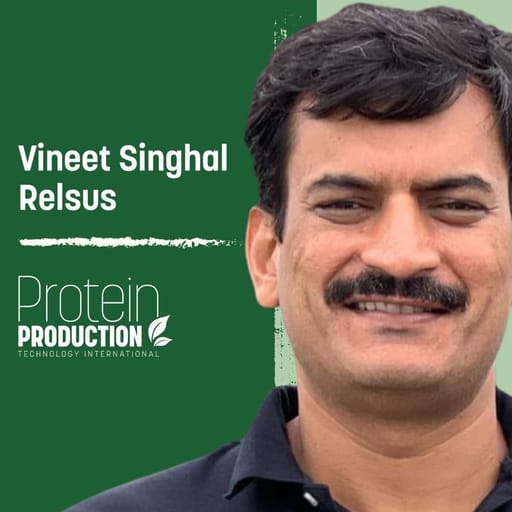
Transcript 0:00 [on-hold music] Welcome to the Protein Production Technology International podcast. We explore the latest advancements in alternative proteins, from cultured meats to plant-based proteins. 0:10 We talk to experts and innovators who are working towards a more sustainable, efficient and kind protein system. Join us as we dive into the exciting possibilities of the alternative protein industry. 0:29 Okay. So I'm really pleased to be joined now by Vineet Singhal, who is the managing director and CEO of Relsys. 0:34 So now, if you didn't know Relsys, they're a Singapore-based company specializing in the production of high-quality plant-based protein and specialty starches. 0:42 Now, founded in twenty twenty, the company's mission is to provide sustainable and healthy food solutions to meet the growing global demand for plant-based products. 0:49 Vineet, welcome to Protein Production Technology International. Thank you, Nick. Thank you very much, and thank you for having me. 0:56 Now, before we get into the company, your company, it would be nice to g-get to know you a bit. So what has been your own journey into food tech? 1:02 I mean, you-- I've seen your CV, and it reads like a who's who of some of the major companies in the world. Yes, indeed. So I've worked for indeed many companies, um, in my career. 1:12 I have, you know, um, experience of more than twenty-five years and have actually worked in many companies, including also, uh, active pharmaceutical ingredients production, which is actually, you know, closely connected to what we are basically doing here. 1:26 And, uh, it even supports, uh, what we are doing because sometimes getting the perspective from, uh, pharmaceutical anti, uh, biodig production in, uh, B2B space actually is, uh, add on, and that we are-- we think, uh, is actually a s- uh, you know, benefit that we're able to carry on into the, uh, food ingredients, you know, business. 1:45 Uh, probably I can also explain during the course of, uh, our interaction later on, uh, how it's actually helping us in this. 1:51 But besides this, I've also, um, you know, uh, overseen businesses of, um, um, overall nutrition, uh, but also in very different industries which are not exactly directly related to food tech, but at the same time, um, you know, helps in overall getting the outside-in perspective. 2:08 Mm-hmm. N-now, given your company's role in, um, um, plant-based proteins, I'm keen to understand the company's origins and, and the specific factors that drove, um, to its establishment. 2:17 Could you elaborate on the inspiration behind founding the company, uh, and the perspectives that the founding team brings to the table? Yeah. So, um, you know, Relsys is founded by, um, 2:28 a team of five, uh, highly experienced people with combined experience of about one hundred and twenty-five years. 2:36 Out of that, uh, majority, a bulk of that experience comes from, uh, you know, working for an API company, uh, you know, multinational active pharmaceutical ingredients company, where, um, our... 2:48 one of the founders is, uh, you know, has been working on the R&D part. 2:52 He has, uh, you know, uh, co-owned certain patents, uh, in various technology, which are actually very directly related to the technology that we have developed in Relsys. 3:01 Uh, one of the co-founders, uh, has been working, uh, during his career in projects and operations and continuous improvement. Uh, that is also very relevant to, you know, Relsys. 3:10 And one of the co-founders, uh, you know, has been working on global marketing and sales and has been spearheading the cause for, uh, sustainable antibiotics, uh, to overcome the antimicrobial resistance, uh, that has been, you know, uh, spreading throughout the globe and also the pharmaceutical companies, uh, in a way also contributing to it. 3:29 So she has been actually spearheading, uh, the, um, response from the pharmaceutical companies to fight against the AMR. 3:36 And one of the co-founders, uh, has been, uh, our finance and control, uh, CFO, uh, basically for, um, the business unit, uh, Asia, Middle East and Africa. 3:46 That company and myself have been actually leading the company, uh, for, uh, the business unit Asia, Middle East and Africa of this company, and thereafter also for other companies, uh, both regional as well as the glo-global roles. 3:58 So this is the company, uh, you know, founders. Um, so very strong pedigree, um, of the founders. 4:05 Now the motivation for, um, you know, finding this company and then, you know, working on plant-based proteins actually has been that, you know, we have actually worked, uh, extensively during our careers, long careers. 4:17 Um, but when we look at, um, overall climate change and the, uh, response, and we feel that it's our collective responsibility, especially for our generation, we believe it's our responsibility in this generation to leave a better world for the next generations. 4:32 And, um, from the perspective of, you know, working for last about twenty-five to thirty years, uh, in our careers respectively, um, why not, um, spend rest of our, you know, careers actually fighting the climate change? 4:47 And when we look at, um, you know, overall the contributors for greenhouse gas emissions, we believe, um, you know, based on all the, um, you know, readings, about more than one third of the global greenhouse gas emissions are coming from the current food systems. 5:02 And, uh, protein transition essentially is, um, you know, we believe, um, an area which is absolutely needed, without which we cannot really, uh, achieve our Paris climate, uh, degree, uh, targets. 5:14 And according to our own experiences and we believe the technology that we can visualize, and, you know, based on the discussions that we have been having with the customers as well as trade industry members, we believe if, uh, some of the roadblocks that the industry has been facing can be overcome, for example, on the functionalities and, uh, you know, the, the sensory profile, uh, of the products, besides of course, um, you know, the clean and, uh, you know, hygienic and, uh, security of supplies. 5:42 If you're able to solve those technological and business, uh, you know, model solutions, um, we can actually make a positive impact towards the protein transition. That has been the biggest motivator for us. 5:55 One is personal, that we believe it's our personal responsibility as, um, you know, um, experienced professionals-To not leave the world which is, uh, worse than actually when we took over, uh, you know, ourself, um, you know, in the, in the industry. 6:11 That's one. 6:12 And second, based on their experience, which is, uh, you know, mainly coming from the pharmaceutical ingredients, uh, you know, working on various technologies, we believe we can actually, uh, you know, solve a problem of protein transition faced by the plant-based proteins, and we can contribute positively. 6:27 That was whole purpose of building Rel sas. And we, you know, feel very, very proud of what we actually, uh, you know, did. 6:36 Um, and I think, uh, we have crossed several, you know, uh, choppy waters, I must say, [chuckles] over the last, uh, you know, four years. 6:42 And we've come to a stage where we think, uh, you know, we, we are, uh, contributing now and, you know, play to really, uh, make an impact. Yeah. 6:52 No, you should be proud, and you've achieved, uh, a lot in, um, a relatively short space of time. Now, it's a crowded marketplace as well. 6:58 So could you explain, um, how Rel sas differentiates its approach from other companies in this space? Yeah. 7:05 So as I said, you know, uh, based on our interaction with the industry members, we believe that, uh, there are two aspects that we need to really solve. 7:12 One is, um, you know, getting the right product, which essentially includes, um, you know, getting the right quality of, uh, material to start with, 7:22 both from a sustainability perspective and also from a quality perspective. That's one. 7:26 Second thing, uh, that we understood was the, um, uh, the plant proteins, especially the new generation plant proteins, were not necessarily meeting the customer requirements in terms of the sensory profile, number one. 7:38 The biggest and the most prevalent problem was that the plant proteins were giving some beany taste, flavor, off notes, et cetera, and that's not helping in formulating the applications. 7:50 So for us, the, uh, task was, if you want to solve this problem, we need to basically solve two prong, uh, you know, problems. One is on the supply side. So supply chain has to be absolutely robust. 8:01 The second thing is that the technology has to be-- The extraction technology has to be so robust that it is, uh, meeting all the key objectives of, um, you know, having the right quality consistently, number one, and the right quality must include the, uh, functionality, sensory profile, and also it must be produced sustainably. 8:21 Mm-hmm. So all these things that we have basically solved is through, um, I would say the two-pronged approach. One is, uh, backward integration. 8:30 Our business model is actually backward integrated, which means that we have strong, um, you know, supply network. So we have our own farms as well. 8:38 So actually we started set-- by setting up our own farms, where we, uh, converted the farmland into organic, uh, you know, farmland. Also, we selected the raw materials which are, you know, uh, intrinsically sustainable. 8:51 Mm-hmm. So the, the chickpea, mung bean, pea, so these are the, uh, you know, uh, legumes which essentially not, not, are, are not only, uh, less resource-intensive, they even infuse, uh, nitrogen into the soil. Mm-hmm. 9:08 They actually accelerate, um, the, uh, conversion of land into an organic, uh, you know, land. So that's essentially the raw material. 9:17 And, uh, we actually have also partnered with some farmers to be able to supply us the, uh, the quality of raw material that we are actually needing. 9:26 Also, we have partnered with the premier Indian Institute of Pulse Research, and they have been into this particular, you know, business, this, uh, industry of, uh, you know, getting the right quality of pulses, uh, for the Indian, uh, conditions, which help us to get the proteins in terms of the, the legumes which are of high protein content, are resilient, so we don't need to use the pesticides. 9:50 Uh, also the, um, you know, proteins do not need fertilizers because they themselves are working as fertilizers for the soil by, by fixing the nitrogen. 9:57 So by partnering with IIPR, Indian Institute of Pulse Research, having our own farms, and having a network of farmers to be able to secure these, uh, you know, sustainable products, we have actually secured our supply chain. 10:10 That's, you know, one part. 10:11 The second part is, uh, developing a technological platform, and that we have been successful in developing a technological platform which is proprietary to us, and that we call as ultra-precise filtration technology, where we actually use, uh, a multi-stage membrane filtration, which are customized for our requirements. 10:30 And that's essentially the work that we've been doing for the last four years on research side, to be able to develop a technological platform that delivers consistent quality that meets both functionality as well as the sensory profile, which is, uh, without any off notes, uh, without any beany taste, bitter note, et cetera. 10:50 So these are two, I would say, the, uh, most important differentiating factors for us, uh, that we believe, uh, is enabling us to solve the long-standing problem that industry has been facing. Mm-hmm. 11:02 Now, now, chickpea, mung bean particularly, um, they're proteins that have emerged as a promising ingredient in the plant-based food sector. 11:08 So given your expertise in the area, I'd like to, um, delve deeper into the specific properties and applications of these, um, sources. 11:15 Could you tell us, um, a little bit more about some of the unique advantages they offer compared to other plant-based proteins? Yeah. 11:22 So, um, chickpea protein, for example, has, um, first of all, um, as I said, you know, one is only sustainability side itself. 11:29 So one of the most sustainable crops, uh, I would say, are chickpea, mung bean, most sustainable. They don't require any, um, you know, natural resources. 11:39 It basically is a dry season crops, so we don't need, uh, to give them water. Um, they're grown typically in a time when, uh, even rains are limited. 11:49 So dry season crops, very limited water consumption, very limited any other, um, nutrient consumption. Um, and they basically fix the nitrogen, uh, in the soil for, you know, rotation of the crops as well. 12:02 That's one advantage. 12:03 Second advantage is that from a health perspective, they are actually full of, uh, um, micronutrients, besides the amount of protein, because, um-From either-- as a dry matter, the protein content in chickpea and mung bean is up to about twenty-five percent. 12:17 Um, so high, uh, protein, but at the same time, it's not just restricted to protein, uh, you know, content. It's also, you know, full of micronutrients. 12:25 Micronutrients such as, uh, you know, zinc, iron, selenium, uh, magnesium, manganese, uh, you know, uh, phosphorus. So it's actually full of, um, you know, micronutrients. 12:36 So that's, I think, uh, the other thing that, uh, is actually helpful in this. Mm-hmm. 12:41 The third thing is that, uh, uh, because of our technological, um, you know, platform that we have created, so we're not using any solvent, we're not using any harsh chemicals. 12:50 Uh, you know, uh, our process is actually water-based, but also based on, you know, the entire filtration technology. 12:57 So we are-- From a, um, perspective of giving a final product, we are actually much superior compared to the traditional, uh, method of production or extracting the protein. Mm-hmm. 13:08 With our process, we are able to eliminate, uh, the, uh, impurities, uh, some of the anti-nutrition compounds, uh, some of which are responsible for the, uh, you know, uh, beany taste or off notes. 13:22 That we also are able to remove, but also we're able to remove some of the anti-nutrition compounds which they prohibit the absorption of these micronutrients into the body. Mm-hmm. So therefore, um, 13:33 you know, the proteins that we, uh, produce are not only rich in protein, but they are rich in, uh, micronutrients which are also available for absorption in the body. Mm-hmm. 13:44 Now, you previously talked about the supply chain. Um, now a key concern in the food industry is ensuring that, um, supply chain is ethical and sustainable, um, in terms of the sourcing practices. 13:53 So how do you address this issue with your protein supply chain? Are there any certifications or, or standards in place to guarantee responsible sourcing or, or cultivation? Yeah. 14:03 So the interesting thing is, um, if you look at supply chain, there are few topics I think that we should, um, you know, address as an industry. 14:11 Um, in the FD space, of course, um, you know, plant proteins are coming from plants, of course. Uh, um, so the production of our proteins is taking place, um, in an area which is considered to be, um, 14:26 um, you know, the most producing area for, uh, the pulses, um, in India. And India as such is, uh, producing about two third of, or even more than two third of, uh, the global chickpea production. Right. 14:41 Similarly, mung bean, it's producing one of the largest quantities by far of mung beans globally. Mm-hmm. Pea as well, it's, uh, second or third largest producer of pea. 14:52 Um, for rapeseed, um, also about second-largest producer of rapeseed, um, you know, crops. 14:57 So India, we have actually set up the plant in India, uh, in the region which is, um, actually the hub of producing high quality, uh, of pulses and the crop that we're using. 15:09 So one is the proximity of the raw material sourcing, so that we don't have to really import or we don't have to bring, uh, by long distance the raw material to our, you know, facilities. That's one. 15:21 That helps in, uh, reducing our carbon footprint. 15:24 Second thing is that, uh, because we've set up our own farms, our own model farms that we have converted into organic over the last four years, we are in the process of getting the organic certification. 15:35 Uh, we are also-- we have partnered with the farmland which the, the farmers and the FPOs, the Farmer Producers Organizations, in the nearby area, 15:44 where we are able to also positively impact the, uh, farmers' income- Mm-hmm... by giving them the access to the high quality, um, you know, seeds for these, you know, crops by way of our partnership with IIPR, 16:00 um, which is the institute, which is actually pioneering institute in, uh, you know, doing the research on pulses. 16:06 Uh, so through our partnership with IIPR and partnership with the FPOs, we're able to bring the best of the pulses or pulse seeds varieties to the farmers and the practices which are organic in nature. 16:20 And by any means, we know that these seeds, uh, do not require, uh, either pesticide or, uh, fertilizers because they are actually very less resource intensive. 16:31 So by doing this, we are able to have oversight, because it's close to us, we're ab-able to have oversight on, uh, the, uh, raw material sources, 16:42 have good quality of seeds, and that essentially helps us also to get the, um, entire traceability for our raw materials and gives us confidence that the technological platform that we have, uh, used is, uh, you know, uh, not basically, uh, used for low quality of raw material. 17:02 We are using high quality of raw material and using, uh, our high quality and, you know, advanced technology to actually produce a very high quality of, you know, finished goods. That's the system that we've used. 17:14 Mm-hmm. From certification perspective, as I said, we have, uh, already, uh, you know, applied for organic certification and I think, uh, we should be able to get it by Q4 of this year for our own farms. Mm-hmm. 17:24 And for the partner farms, uh, depending upon also requirement of the customers, um, if required, we can actually have, uh, you know, sourcing from the organic farms. 17:35 Uh, but if not, um, at least our final products also, thanks to our technological platform, uh, the final product is still do not carry any, uh, uh, pesticide, et cetera, for two reasons. 17:48 One, that, uh, um, our supply chain partnership, uh, helps us, uh, to, uh, eliminate, uh, the usage of, uh, you know, pesticides as first step. 17:58 Second step, um, is that anyways these crops do not require pesticides, so even if the farmer, um, you know, would, um, be inclined to actually increase the productivity, et cetera, do not necessarily need anyways the pesticide. 18:11 Third thing is- Mm-hmm... the third level of defense for us is the entire technological platform. 18:15 The filtration technological platform that we've usedAnyways eliminates the impurities, et cetera, including the pesticides. So, um, we have three level of, you can say, uh, protection system that we have employed. 18:25 Mm-hmm. And of course, these, uh, benefits that you can pass on to your customers as well. 18:30 Now we're gonna talk about the extraction process, which can significantly, um, impact the quality and functionality of plant-based proteins. Could you describe the specific methods that you employ to extract- Yeah. 18:39 -the protein from those plant sources? Yeah. So, um, like as I said, um, we have developed a system. In fact, this is also, um... 18:50 We start working on this, you know, platform already, uh, from the beginning because we knew that the problem that the industry is facing, and we have actually interacted with many, um, you know, technological, um, providers, equipment providers, et cetera, throughout the globe. 19:04 And we understand the, the challenge the industry is facing is going to be difficult to solve without actually thinking completely different. And that's why I said, um, 19:16 coming from active pharmaceutical ingredients industry and having worked on many different, uh, you know, products and using very, uh, many different type of technologies for, uh, you know, uh, processing, uh, the products, 19:29 uh, we actually leverage our experience on that. And we actually developed, um, a customized system which is, uh, you know, working on membrane technology, but it's not just a normal membrane technology that we're using. 19:41 So we're using a multi-step, uh, membrane technology, customized membrane technology, um, that essentially helps us to, um, eliminate. So it basically does, I would say, three, um, you know, um, uh, benefits. 19:56 Yeah, it gives us three benefits. One benefit is that, uh, it eliminates the impurities, uh, anti-nutrient compounds, the multi-stage membrane system. 20:05 The second thing it does, uh, it also removes, uh, the, um, off-notes, beany, uh, taste, uh, bitter note. 20:14 Initially, uh, when we started working on our first phase and second phase of our product development, uh, technological development, we were not successfully able to remove the off-note and beany taste. 20:26 However, in the third, um, you know, phase of our technological development, we were able to remove, uh, even those, you know, beany notes and, uh, you know, bitter notes and, uh, off-notes. 20:37 The other benefit that it does is that, uh, um, it ensures that the, uh, micronutrients are concentrated well. Mm-hmm. Uh, they're not eliminated. 20:49 In the traditional process, uh, they're able to generally concentrate mostly globulins. However, and, uh, albumins are essentially still, uh, filtered out. 21:01 However, in our process, we're able to also concentrate the albumin. So we have a much more robust, uh, protein, which has both the components of albumin as well as globulin. 21:12 It has, uh, concentrations of micronutrients, but it eliminates what we don't want. All the impurities, anti-nutritional compounds, uh, odors and off-notes. 21:25 That's the benefit of our technology platform, and that we call it ultra-precise filtration technology. That's our appropriate filtration technology. 21:33 Could you provide, um, any further detail on the nutritional profile of some of your key proteins, let's stick with chickpea and mung bean, um, including that concentration and any variations depending on the specific product or, or application? 21:47 Yeah. So chickpea protein has, um, more than seventy percent of, uh, protein purity. 21:53 Uh, it also comes with, as I said, the micronutrients, uh, which are, um, you know, long list of micronutrients, uh, like, you know, iron, zinc, selenium, magnesium, manganese, um, um, calcium, copper. 22:08 Um, so you know, very good quality of, uh, micronutrients, uh, in the protein. It also has, uh, largely, um, polyunsaturated fat, uh, which is essentially a good, good quality of fat, as you know. 22:23 Um, also helps according to th-these, you know, scientific papers, uh, chickpea fat has a very good, you know, quality, and it also gives, from a functionality perspective, a premier, you know, texture. 22:34 So chickpea protein, um, can be used, and we have applications developed, um, can be used very well for, um, alternative for creamer, for example, uh, or milk or any other dairy products. 22:48 It's a very good product for that. 22:50 Mung bean protein comes with, uh, minimum eighty percent of, uh, protein, uh, concentration, and, uh, it also has, uh, micronutrients which, as I explained for chickpea, is also applicable for, you know, mung bean. 23:03 Uh, very limited amount of, um, you know, uh, fat, very limited amount of, uh, carbohydrates. So very good quality of protein. Uh, from a texture perspective, also, uh, very, very nice texture. 23:14 Uh, it can be used for, uh, egg replacement, but also for, uh, you know, um, the, uh, you know, meat replacers, uh, or other beverages. Mm-hmm. We're gonna talk about the sensory properties, um, in a second. 23:28 But in terms of, um, customization and flexibility, meeting the needs, the diverse needs of customers in this sector is, um, crucial. So how do you, um, customize solutions to meet those specific requirements? 23:39 Are there any limitations or, or challenges in developing custom products? Yeah. So, um, 23:46 from customization perspective, um, while there are of course limitations, um, you know, that's given by the, uh, you know, raw material itself, however, there are still room for, uh, making some adaptations, et cetera. 23:57 Uh, so recently our R&D team, um, completed a project, and it was essentially on the functional starches. Uh, so the requirement from a customer was to replace... 24:07 They, they wanted to replace, uh, um, the modified starches from their applications, and they wanted to replace that with clean label starches. 24:14 Um, so our team actually, you know, gave them a solution using chickpea starches, um, that actually gave them the functional properties even better than the modified starches, which were modified through a chemical process.Um, and that was possible using our chickpeas starches. 24:31 So I think similarly the protein segment as well, uh, the proteins can be used, uh, uh, for, um, you know, beverages because it has, you know, very high solubility. 24:40 So our solubility is, uh, higher than the conventional, uh, you know, protein, uh, which are available in the market. Um, and similarly, the emulsification is pretty high. 24:50 Uh, so, um, customizations are possible, um, and that we can do, um, also by tweaking some of our, uh, you know, process steps. 25:00 Uh, if someone wants really very high gelation, that's possible of compared to someone who wants, uh, significantly higher, you know, solubility. 25:08 As such, in our standard product, we have both solubility, um, emulsification, as well as, uh, um, you know, gelation properties, uh, which are, 25:18 uh, you know, higher than the, uh, you know, conventional, uh, conventionally produced proteins. Now, you talked about texture before. 25:24 Now, one of the challenges, the big challenges facing the plant-based, um, protein industry is ensuring the products meet the sensory, um, expectations of, of customers or consumers. 25:34 So how, how are you addressing that issue, and what measures are in place to ensure that your products are appealing to a wide range of your customers and hence they pass those sensory properties on to their final customers? 25:45 Yeah. Yeah. Nick, I think, um, uh, you touched, as I said, you know, a very, very important topic and also based on our, uh, discussion with the customers and industry players, I think the, the sensory profile 25:57 has been one of the biggest roadblock, um, why the plant protein. I think plant proteins, uh, should basically grow much, much faster. 26:05 It is growing, uh, fast, uh, I would say, but at the same time, um, looking at the potential and also looking at the, um, requirement, uh, to meet the climate, 26:16 uh, um, you know, action, uh, and especially the speed which is required to, uh, really mitigate, uh, the climate change. But I think we basically need to move faster on the, on the protein transition. 26:27 And I think one of the, uh, challenge has been on sensory profile. Um, we also faced, I, I must say, I must confess that over the last four years, we have also had our share of challenges. 26:39 So when we launched the first, uh, based on our first technological, uh, step, let's say first wave of, uh, technological development and even after second wave of technological development, uh, we had some challenges of, um, um, you know, beany note, uh, off-note, etc. 26:55 Uh, however, um, I can very proudly say, uh, that with our third wave of technological development and now, uh, the technology, as I said, ultra-precise filtration technology, um, we are able to remove, um, the beany taste, the bitter note, the off-note, so neither the flavor 27:18 nor the odor is, uh, you know, coming into the final products, and we are able to have test this consistently. 27:25 And that's the beauty of our, um, technology, which is not about, uh, let's say in one batch it'll be good, in second batch it'll be bad. 27:33 Um, it is consistently batch after batch, uh, now a consistent quality, uh, that basically will not have any challenges on, uh, beany note or bitter note, etc. 27:45 You've covered off the, um, amino acid profile quite well, so we're gonna talk about the functional, um, properties now. Um, this is crucial for their application in various food products. 27:53 Can you ela-elaborate on the solubility, emulsifying properties and, and water-holding capacity, for instance, of, uh, some of your products? Yeah. Yeah. So the solubility, uh, we have actually, uh, done benchmark. 28:06 Um, and 28:08 I would be hesitant to give you a number, uh, because in the industry, I've seen that, uh, the numbers are, um, very different, differently reported because the, uh, the way the tests are carried out are also very different. 28:21 So therefore, I think it's best to actually give you, um, let's say based on index, how did we find compared to the, uh, proteins which are, uh, sold in the market currently. 28:31 So we did a benchmark in our solubility, um, when we actually based on our first wave and second wave, we were able to get, uh, solubility which was anywhere between one point two to one point five times of the, um, the benchmark, uh, material that we actually have, uh, from the market. 28:48 After our third wave of technological development, we're able to hit about one point eight to two X of, uh, the solubility index. 28:56 So, um, our solubility is actually very high for the products, and I think the reason for that, scientific reason for that, as I mentioned, is that we're able to, um, also concentrate the albumins besides the globulins. 29:10 Uh, and albumins are essentially helping in, in both, uh, solubility as well as on emulsification properties. Um, and that's essentially something which, um, we are able to provide from a functionality standpoint. 29:22 On the water-holding capacities and the gelation, um, you know, properties, um, our protein, because also there the play comes mainly from the globulin side, um, we're able to concentrate the globulins very, very well as well, uh, comparable to the conven-conventional, you know, proteins. 29:38 And that's why the, uh, gelation properties and the water-holding capacities are also comparable, uh, to, uh, the traditional- traditionally produced, uh, you know, proteins. 29:47 So I think, um, if I were to talk about, for example, the, um, some specifics of, let's say, foaming, uh, aspect, yeah. If, if you're using, for example, eggs. 29:57 Uh, egg is used for, you know, very high, uh, foaming or, uh, you know, um, emulsification. 30:03 Some of the applications which require egg for, um, baking, etcetera, there if you use, uh, you know, mung bean protein, you will be able to have actually similar, um, um, um, properties compared to the eggs. 30:14 If you look at some of the applications where people are using dairy, um, if you compare that with, uh, chickpea protein, you will be able to have similar or even better, you know, properties, functional properties, um, uh, uh, from chickpea protein. 30:27 So I think, um, overall, I would say, um, the functional properties, um-On sites of solubility to, uh, emulsification to foaming to, um, you know, gelation properties. 30:41 We have actually a very good bouquet, um, of, you know, proteins which are able to solve, um, the varied and also very demanding application requirements. Mm-hmm. 30:52 Now, given the, the increasing popularity of, um, plant-based products generally, what are your plans for expanding, um, your market reach both domestically and internationally? 31:01 I mean, you're based in India at the moment. You're a Singapore company. Um, you've already [chuckles] got an international, um, outlook. So are, are there any specific regions or target markets that you're prioritizing? 31:11 Yeah. So, um, so basically we have, of course, headquarters in Singapore and therefore, um, the Southeast Asian market and also Northeast Asian markets, um, you know, we are featuring from Singapore. 31:23 Um, having a base manufacturing, uh, base in India helps us to cater to the South Asian market very well. 31:29 Uh, we're already in discussions with a company in Europe, um, to partner with them to make the access easier for the European customers. 31:38 And for, um, the US market, we are also, you know, we-we'll be showcasing ourself in, um, the, um, FI-- um, North America in Las Vegas- Mm. -um, in October. 31:50 And, um, we'll be also looking at, um, you know, some partnerships possibilities, uh, in the US, um, in whichever form, uh, makes sense, um, to actually also have access to the customers in the, in the US. Okay. 32:04 And we're also thinking of actually having our own subsidiary i-in the US for, um, being close to the customers in the US. Mm-hmm. So big plans on the, on the horizon. 32:14 Now bringing a new product to the market can be challenging. Um, so how has your commercialization journey been so far? What challenges have you faced and, and how have you responded to those challenges? Yeah. 32:25 I think, um, so what we did basically was, um, to have, you know, from a s- business model perspective, we were very clear. Um, we, we scanned the whole market. 32:36 We looked at, um, you know, various products, um, both from, um, um, you know, reading as well as from experiencing perspective. We, um... 32:45 And therefore, we selected the region, um, first of all India as a place, uh, to set up the plant, uh, because of, um, the raw material security supplies for the selected raw materials. 32:57 Second, also the location of our, um, you know, uh, farmland and the extraction plant we chose based on, uh, the location where the, the s- the soil conditions were most suitable, where, uh, the most of the production, existing production takes place for the pulses and the quality of, uh, uh, you know, climatic conditions and of course, uh, uh, the conditions for, um, uh, you know, doing business, uh, in the state, um, of India. 33:25 So that was essentially, um, that we did, uh, well. The challenge that we basically faced, while I think we had the right technology, but it does take time. 33:33 Although, um, four years, uh, of time, you can, you can see this as too long, you can also see this, uh, as too short, uh, for us. 33:43 Um, you know, we felt-- we hoped to actually achieve this in two and a half to three years time, uh, what we achieved so far in, in four years. So for us then it looks a little bit longer than what we had anticipated. 33:55 So this was one of the challenge. And I said, uh, 33:59 we planned to, um, you know, find a solution for also the entire sensory profile over already in about two and a half years, but it took almost about three and a half, uh, you know, years for us to reach that stage. 34:12 Um, but we did face a challenge of really not being able to meet, uh, you know, some of the requirements of the customer's sensory profile initially. 34:20 Uh, but then we actually, um, were able to solve it and solve it for good. Mm. That I must say. And I think, uh, now we are in a stage based on the feed-- the positive feedback, um, for our, the latest product profiles. 34:34 Um, we're able to get very good, you know, customer feedback. 34:37 So now we are in the stage of, um, um, you know, constructing a greenfield project, which can basically, uh, process sixty thousand tons of, uh, uh, raw materials annually. 34:49 And, um, so site is under construction, and the first phase of that construction, um, will be completed and will have the commencement of, um, uh, production, uh, from this facility in Q4, uh, in the coming three months. 35:03 And, um, uh, the first phase will only, uh, have commercial production that can take care of the customer requirements. 35:11 And then we'll keep, uh, expanding that phase, I mean, coming to next phases of the production to be able to reach, um, the maximum capacities of this greenfield project. Mm-hmm. 35:22 Now all of that takes money, so financial resources are crucial for growth and innovation. So are you well-funded to achieve your scale-up plans? 35:28 Uh, um, what are your funding strategies and, and projections for the future? Yeah. So, um, we are actually well-funded. 35:35 So, uh, first of all, um, all the co-founders actually, uh, invested, uh, money over last four years, and thereafter we also took, uh, the bank loans. 35:43 So banks have been kind to give, um, decent amount of, um, uh, long-term funding to us, uh, to set up the plant. And we have also been ab-able to, um, you know, have the external investor for our, uh, expansion of plant. 35:55 So we have basically, um, you know, both hard commitment as well as soft commitment for not just the current phase of, um, you know, which I said the commercial production will commence already in December, uh, latest by December, but also for the next phase, uh, which we, uh, plan to also commission by next year, by the end of twenty twenty-five. 36:16 That will be expansion of the project. Essentially next phase of our, um, greenfield project. Um, now I've just got a couple of questions, um, Vineet. 36:25 Um, in terms of future research and development, innovation is obviously key for food tech. Um, what are your plans, um, for future R&D in the area of plant-based proteins? 36:33 Are there any specific areas or technologies that you're focusing on?Yeah. So, um, we basically plan to, uh, continue to work on R&D, because R&D of course is the key and, and the heart of, uh, Munnerals's. Um, 36:47 so even today we have-- R&D is the largest team, um, you know, in terms of the total team members besides the production people. Um, so, uh, we'll continue to work on the R&D and strengthen the R&D. 37:00 We'll basically work on two sides. One is on the process side itself, uh, we'll actually onboard more protein. 37:06 So if you look at my R&D pipeline, there's a quite long R&D pipeline, um, you know, list and, uh, which has, um, additional, um, you know, plant proteins. 37:17 So we'll also work on, for example, the, um, some of the oil seeds, uh, besides, uh, canola. We'll look at those. 37:24 We'll also look at, uh, um, some of the, um, legumes or, um, um, some other sustainable, um, you know, plant sources. We'll look at those. We'll onboard those, um, you know, products as well. 37:37 On technological platform, I think with technological platform will help us, uh, to work already on these new products, uh, as well. 37:45 If there will be any requirement for tweaking, that should be also possible in the R&D phase. We'll continue to also work on the functional starches. 37:51 I think we have come a long way, uh, on functional starches because, um, uh, the side streams, we are able to use them not just to, um, you know, sell as a, uh, just a side fiddle, but to really make a good, um, impact on that particular aspect as well. 38:07 As I said, um, the functional starches that we have, um, you know, produced, we are able to have replacement of the modified starches with similar or better functional profile. 38:18 So they are, um, you know, the chickpea starch, mung bean starch, and pea starch, they're able to replace, uh, the modified starches. Similarly, we'll also look at, um, adding in our portfolio the dietary fibers, 38:31 uh, which will come from also, uh, our, you know, protein supply chain. So, um, you know, canola protein, similarly, uh, from a plant protein we'll be able to have also separation of, um, dietary fibers. 38:43 That's the new area that... So I think, uh, um, these areas as far as the protein supply chain is concerned, and then we'll also look at, um, uh, that'll come in third phase. 38:53 We'll also look at, uh, some of these, uh, um, you know, low-calorie, uh, sweeteners. 39:00 Um, could be monk fru-fruit or, um, you know, stevia, but that's not in, in the immediate horizon, but it'll tell me a little bit, uh, later in the third phase. 39:08 So lots of exciting plans, and perhaps we'll get to talk about canola, um, another time. Now, you're in the plant-based sector, um, but obviously it's quite a wide spectrum of, uh, sources in this industry. 39:19 Um, when you look around at other areas of alternative proteins, what particularly, uh, excites you, um, about the technologies or products that you're seeing, um, being developed? 39:30 You mean besides protein or in the protein space? Uh, in the protein space, yeah. I mean, your, your headquarters are in Singapore, so cell-cultivated meat is obviously- Yeah. So that- -out there already... 39:43 yeah, that's indeed an exciting area. Um, but also the fermentation, because we have some experience in fermentation, um, um, area in the, uh, you know, API industry. So for us, it seems that, uh, 39:56 after plant-based proteins, uh, you know, maybe to expand the answer to your first question as well. So, um, the fermented protein also could be our next area to, to look at because that's- Mm-hmm... 40:07 also an extension of our previous experience. We don't want to go too far, uh, from our, um, let's say core experience and core, core competence. So one is, of course, extraction. 40:20 This is, uh, this we believe of course, we thought it was much easier than it came out to be, [laughs] mainly because of the sensory profile, uh, that we have now been able to solve. 40:30 Um, but I think, uh, um, for us, I think natural inclination would be, um, the plant proteins and then moving to, um, the fermented proteins. 40:42 That will be our, you know, let's say next, uh, wave of, um, uh, you know, proteins. 40:50 连起来 But obviously, honestly, I believe that, uh, um, in the overall journey of alternative proteins, I think plant proteins have already come to a stage of maturity, uh, from a, um, you know, economics perspective as well. 41:04 So I think it makes sense to actually, um, you know, first really solve the key challenge of, uh, uh, protein transition through a economically viable, um, you know, protein source, and that, that's I think the plant proteins. 41:19 Um, and after plant proteins, I think the next stage in my view would be the fermented protein. Um, I think the cultivated meat 41:29 would of course also be on the horizon, but I think from a commercial, uh, viability perspective, it'll take, take little bit longer. At least that's my view. I'm not really an expert, but that's my view. 41:39 So therefore, also for us, um, anyways, the cultivated meat is not in our radar right now. 41:45 Um, our, uh, after plant, uh, proteins, then we'll keep expanding the plant protein portfolio, but besides this, we'll also look at, um, in the next wave, uh, the fermented meat. 41:56 Well, I'll be looking forward to catching up with you in the future, uh, to discussing how those plans have, uh, materialized. Vineet, thank you very much for joining us. 42:04 Um, it's been absolute pleasure and hopefully, uh, we'll get to meet face-to-face one day. Highly appreciate it, Nick. Thank you very much. It was indeed a pleasure interacting with you. Thank you. Take care. 42:14 [outro jingle] Thank you for listening to the Protein Production Technology International Podcast. 42:24 We hope you gained valuable insights and knowledge about the innovative technologies and practices transforming how we produce protein. 42:31 Don't forget to subscribe to PPTI Magazine and follow us on social media to stay up-to-date with the latest news and updates. Stay tuned for more exciting episodes.